

Riptide by Vance Joy is one of those songs that feels made for the ukulele. The chord shapes are beginner-friendly, the strumming pattern has a satisfying bounce to it, and the moment you hear those first few bars ring out, you’ll know exactly why this song has been a go-to for new players for years. If you’ve been looking for a first “real” song to learn, this is a great one to pick.
Here’s what you’ll walk away with: the four chords, the strumming pattern, a simple practice strategy for putting it all together, and a way to play along with the actual track. Let’s get into it.
The 4 Chords You Need to Play Riptide

Good news right out of the gate: Riptide ukulele chords are four of the most useful shapes a beginner can learn. Master these and you’ll unlock dozens of other songs at the same time.
Am — Your Starting Point
Am is one of the easiest chords on the ukulele. Place your middle finger on the second fret of the G string (the top string, closest to you when holding the uke). That’s it. Strum all four strings and you’ve got it.
G — The One That Takes a Little More Work
G uses three fingers, which makes it the most challenging of the four. Your index finger goes on the second fret of the C string, your middle finger on the second fret of the A string, and your ring finger on the third fret of the E string. It can feel like a stretch at first, and that’s completely normal. It clicks faster than it feels like it will.
C — One Finger Wonder
C is the friendliest chord on the ukulele. Press your ring finger on the third fret of the A string (the bottom string as you hold the uke) and strum all four strings. One finger, four strings, full chord. It’s a good feeling.
F — Two Fingers, Clean Sound
For F, place your index finger on the first fret of the E string and your middle finger on the second fret of the G string. Two fingers, and when you get them in the right spots, it rings out clearly. Make sure your fingertips are pressing close to the fret wire to avoid any buzzing.
The chord order throughout the song is Am, G, C — and it repeats almost all the way through. You’ll need F only in the bridge section of the song. Once you’ve got those shapes under your fingers, you’ve essentially learned the whole song.
Strumming Pattern and Song Structure
The strumming pattern for Riptide is where the song gets its character. The pattern most players use is D, DU, UDU — a down strum, then down-up, then up-down-up. It has a slightly syncopated feel that gives the song its signature bounce.
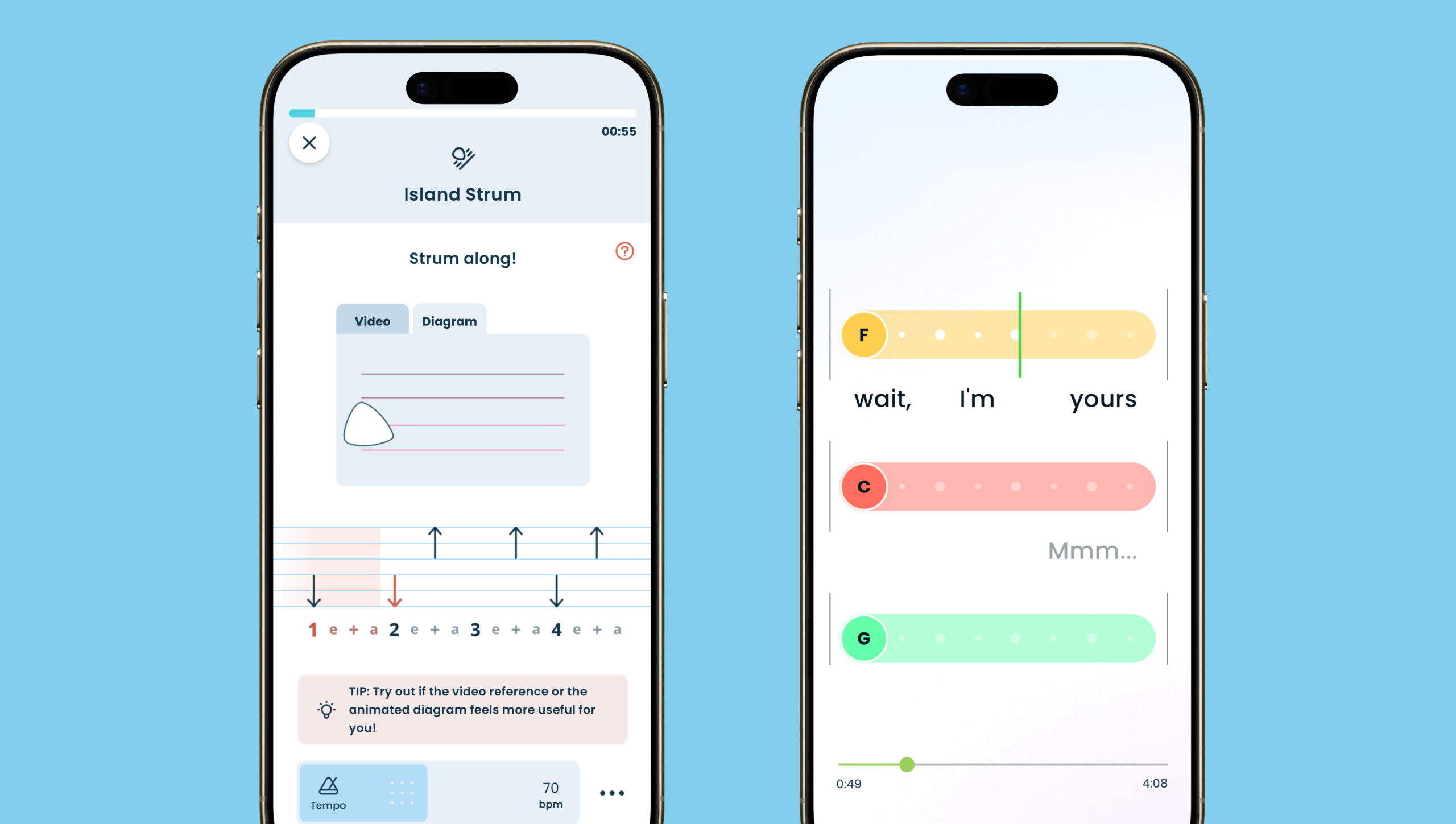
Think of your strumming hand like a windshield wiper that never fully stops moving. Even on the beats where you’re not hitting the strings, keep your hand swinging in rhythm. That consistent motion is what keeps the pattern feeling fluid rather than choppy. If you freeze between strums, the timing falls apart.
In terms of song structure, Riptide follows a straightforward pattern: verse, pre-chorus, chorus, repeat. The good news is that the same four chords run through all of it. The chord changes happen at the same points in each section, so once you’ve learned the verse, the rest of the song will feel familiar.
It’s okay if the timing feels a little rough at first. Focus on keeping your strumming hand moving and catching the chord changes on time, even if the chord itself isn’t perfectly clean. A slightly buzzy chord that lands on the beat sounds better than a perfect chord that arrives late.
How to Practice Riptide Smoothly from Start to Finish
The majority of the song consists of Am to G to C cycle, so it’s good to nail that down first. The key here is to isolate the transitions before you try to play the whole song through.
Start by working just two chords at a time. Go back and forth between Am and G until the switch feels almost automatic. Then do the same with G and C. Once those pairs feel comfortable, try the full four-chord loop: Am, G, C, and back to Am. Keep the tempo slow enough that you can land each chord cleanly before you strum it.
Think of chord transitions like musical chairs. You’re not waiting until the last second to find your seat. You’re watching for it, moving toward it, and sitting down right as the music arrives. That slight anticipation, lifting your fingers just before the strum rather than after, is what makes changes feel smooth.
Once the chord loop feels solid at a slow tempo, gradually bring the speed up. Don’t jump straight to full song tempo. A few sessions of slow, clean practice will get you to performance speed faster than hours of stumbling through it at full pace.
Play Along with Riptide on the Kala App
Playing along with the actual song is one of the best ways to lock in your timing and make practice feel like music rather than an exercise. When you can hear the melody and feel the rhythm of the track, chord changes start to make more intuitive sense.
The Kala App has Riptide in its library of 2,000+ songs, complete with chords, lyrics, and a backing track you can play along with. If full tempo feels too fast, use the tempo slider to bring it down to whatever speed feels manageable. There’s no rule that says you have to play it at full speed right away. Slow it down, get comfortable, and nudge the tempo up as your confidence grows.
The song plays along, and the chords scroll across the screen in time with the music, so you always know what’s coming next. If there’s a section that keeps tripping you up, the loop feature lets that section repeat on its own without restarting the whole song. That kind of focused repetition is where the real progress happens.
If you’re newer to the ukulele and the chord shapes still feel unfamiliar, the structured Learning Path in the app covers all four of these chords with step-by-step lessons before you ever have to worry about putting them together in a song. It’s a solid foundation to build from.
Now go play it. You’ve got the chords, you’ve got the pattern, and you’ve got a plan. Uke on.