
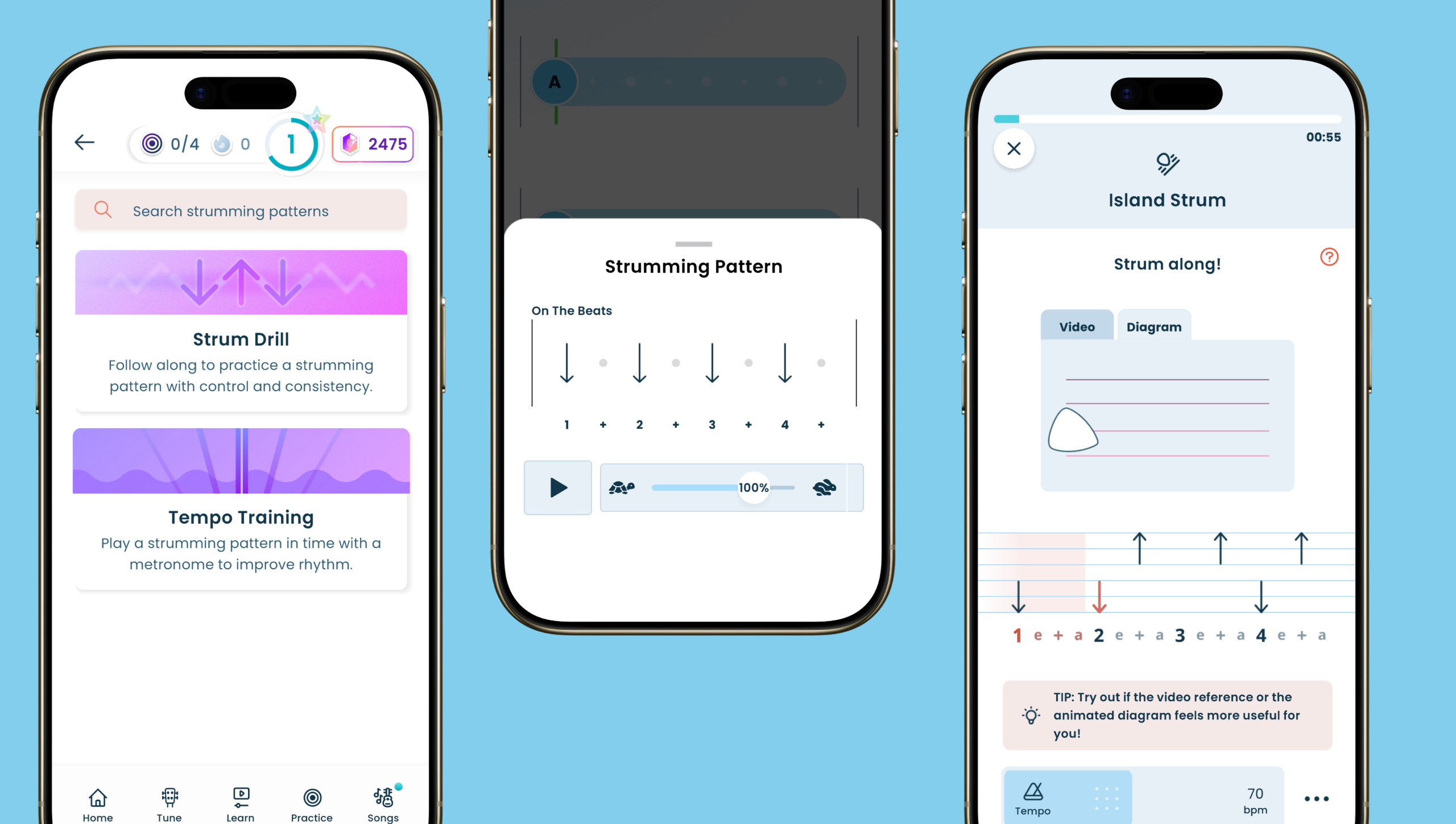
To find the strumming pattern for any song, listen to the rhythm and tap along to the beat. Count whether the song is in 4/4 time (four beats per measure) or 3/4 time (three beats), then notice where the strongest accents fall. From there, match a common pattern to what you hear, or start with the island strum, which works on the majority of pop, folk, and rock songs. The questions below break down exactly how to do that, from listening by ear to picking the right tools to practice with.
How do you figure out a strumming pattern by ear?
To figure out a strumming pattern by ear, start by tapping your finger along with the song and counting. Most popular songs are in 4/4 time, meaning four beats per measure. Count “1, 2, 3, 4” and tap on each beat. Once you feel the pulse, listen for where the strongest accents land, in most pop songs, that’s beats 2 and 4.
After you have the beat, listen for the rhythm on top of it. Think of the beat as the skeleton and the strumming pattern as the flesh around it. Between each numbered beat is an “and”, so the full count is “1 and 2 and 3 and 4 and.” Downstrokes happen on the numbers; upstrokes happen on the “ands.” Your job is to figure out which of those positions the strumming actually hits.
There are two reliable methods for doing this. The first is to listen and count: find the pulse, feel where the emphasis lands, count whether the song moves in two, three, or four, then build the pattern from there. The second is to default to the island strum, which fits the majority of 4/4 pop and folk songs, and adjust from there by feel. Both methods work, and most players end up using both depending on the song.
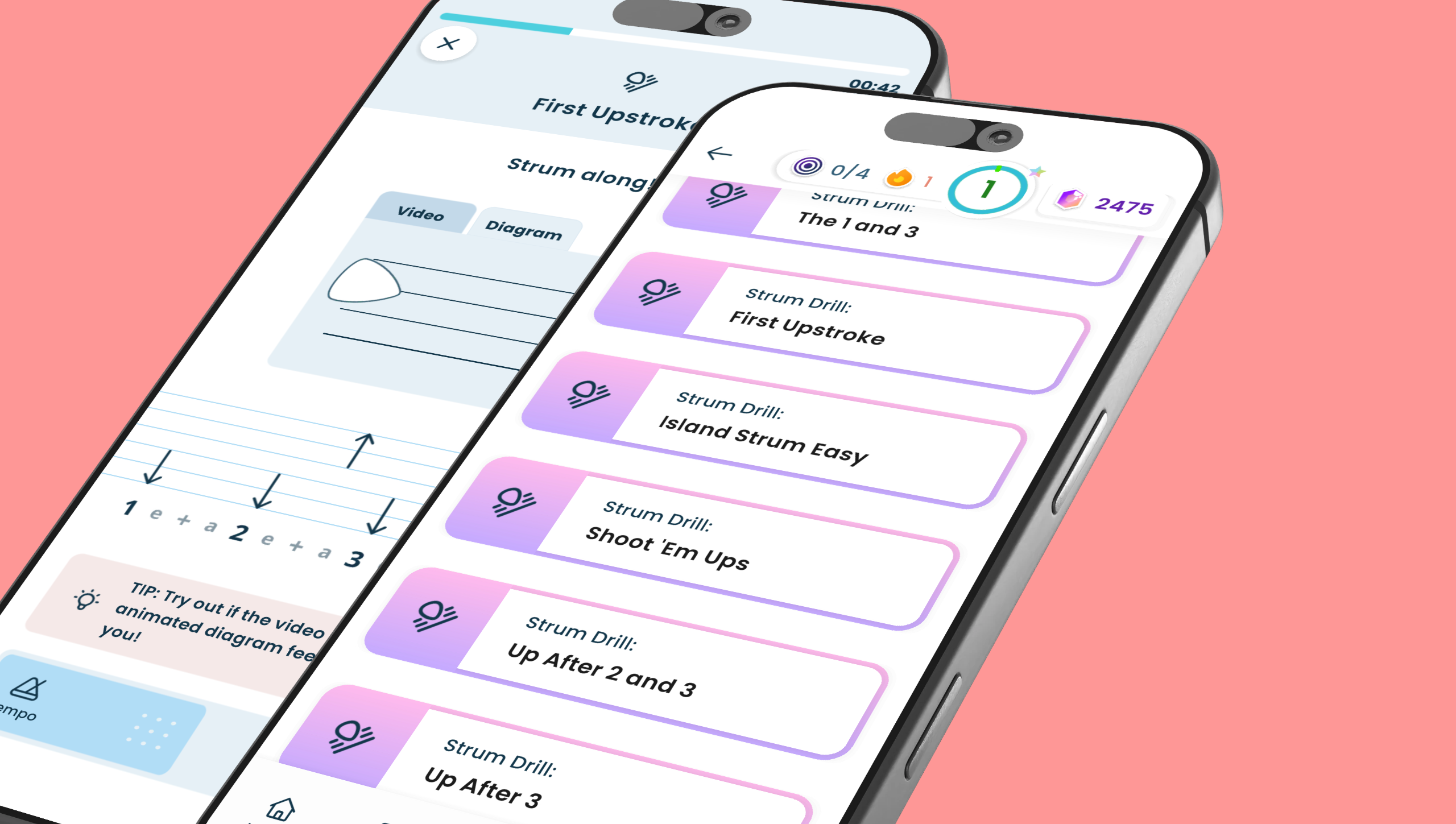
A great song to practice the first method on is Bad Moon Rising by CCR. The pulse in that song is completely unambiguous. Clap along, find the beat, and count 1-2-3-4. The key is D, the chords are D, A, and G, and the tempo sits around 90 BPM — steady enough that the four-beat count locks in almost immediately. Once you can feel the pulse without thinking about it, you’re ready to start layering the strumming pattern on top.
The most practical approach: keep your strumming hand moving continuously in a down-up motion, like a pendulum, and just decide which strokes actually touch the strings. If you stop your hand between strums, the rhythm collapses. Keep it moving even through the silent beats, and the pattern will start to click.
It can feel a little tricky at first, but it passes faster than you’d expect. Think of it less like reading a map and more like dancing, your body starts to feel where the beats are before your brain catches up.
What are the most common strumming patterns in popular songs?
The most common ukulele strumming pattern in popular songs is the island strum (D-D-U-U-D-U), which works across dozens of pop, folk, and rock tracks in 4/4 time. Beyond that, the basic down-up pattern (D-U-D-U-D-U-D-U) and the simple four-beat downstroke (D-D-D-D) cover the vast majority of everything else a beginner will encounter.
A good example of the island strum in action is Yellow by Coldplay. The key is C, the tempo is around 87 BPM, and the island strum fits the song’s feel so naturally that it almost sounds like it was written for it. That’s what it sounds like when the strum pattern and the song are genuinely matched, not forced. If you want a reference for what “right” feels like, Yellow is it.
The four patterns worth learning first
- Four downstrokes (D-D-D-D): One strum per beat. The absolute starting point. It sounds simple, but it trains your internal clock and gets real music out of the instrument immediately.
- Down-up (D-U-D-U-D-U-D-U): Add an upstroke after every downstroke. This is the foundation of everything else, your hand is now doing exactly what it should always be doing.
- The island strum (D-D-U-U-D-U): The most popular and iconic ukulele pattern. It has a deliberate missed downstroke in the middle, your hand keeps moving through the air, but doesn’t hit the strings. That silent beat is what trips most beginners up, but it’s also what gives the pattern its feel.
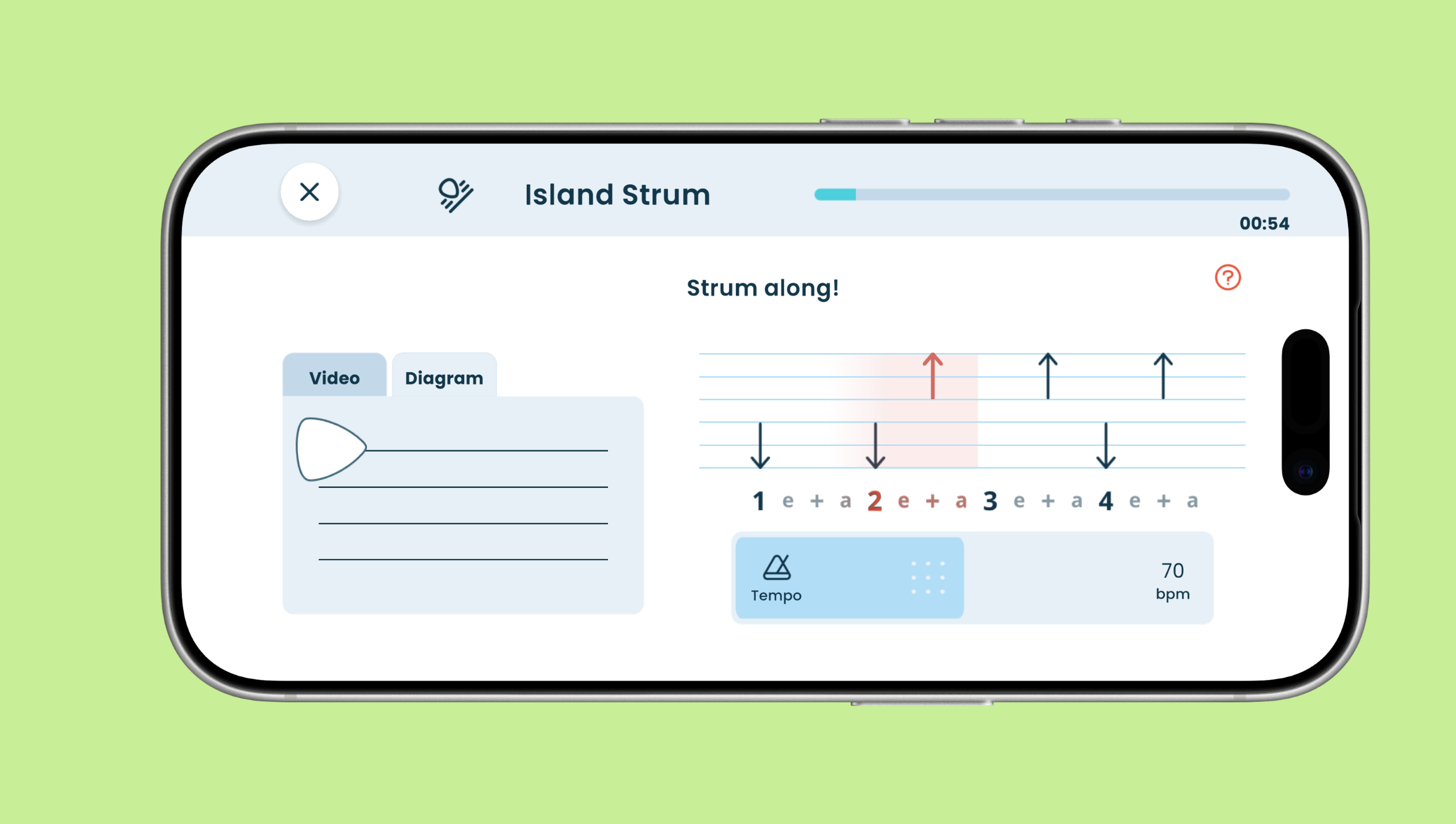
- The waltz strum (D-D-U-D-U): Three beats per measure instead of four. Used for songs in 3/4 time, think folk songs and anything with a swaying, rolling feel.
What makes the island strum so versatile
The island strum works because it sits comfortably in the middle of the rhythmic range, not too sparse, not too busy. It has enough movement to sound musical but enough space to feel relaxed. UkuLenny’s tip for getting the silent downstroke right: whisper “down” on the beat where your hand moves through the air without hitting the strings. That keeps the motion going and the rhythm steady.
How does song tempo affect which strumming pattern works?
Song tempo directly affects which strumming pattern feels natural. Faster songs need simpler, more driving patterns to stay clean and controlled. Slower, more emotional songs have space for more complex patterns, or for fingerpicking instead of strumming altogether. Matching the pattern to the tempo is as important as matching it to the song’s feel.
At a fast tempo, a pattern like the island strum can start to feel rushed and messy. A straighter rock strum, with strong downstrokes on every beat and a driving accent, tends to sit better. At a slow tempo, the same four-beat downstroke that sounds too plain at speed can feel warm and deliberate.
Two songs that show this contrast clearly are Don’t Worry Be Happy by Bobby McFerrin and Three Little Birds by Bob Marley. Don’t Worry Be Happy runs at around 130 BPM with a reggae swing feel — the offbeat bounce is distinctly different from the island strum and easy to hear once you’re listening for it. Three Little Birds is slower, around 74 BPM in the key of A, and uses a reggae offbeat feel where the strum hits only on the “and” of each beat. That single difference — landing on the offbeat rather than the downbeat — is what gives reggae its characteristic lift. Hearing both songs back to back makes the distinction between swing feel and reggae offbeat immediately obvious.
A good rule of thumb: if a pattern feels uncomfortable at the song’s actual tempo, the pattern isn’t wrong, the tempo is just too fast for where you are right now. Slow the song down, get the pattern clean, then bring the speed back up gradually. The pattern will feel completely different once it’s automatic.
Should you always copy the original artist’s exact strumming pattern?
No, you don’t need to copy the original artist’s exact strumming pattern, and most of the time it’s not worth trying. The strumming pattern on a recording is one interpretation of the song, shaped by the original instrument, production choices, and the player’s personal style. On ukulele, a pattern that fits the feel of the song matters far more than replicating the original note for note.
UkuLenny puts it directly: “the strumming pattern is just meant to be an example — use it to inspire your own strumming.” Use it as a starting point to inspire your own approach. If the island strum fits the song’s feel, use it. If a simpler pattern lets you focus on chord changes without losing the rhythm, use that instead.
The goal is to make the song sound like music, not to pass an accuracy test. Once you’re comfortable with a basic pattern that fits, you can experiment with variations, add accents, or adjust the rhythm to match your own sense of the song. That’s where strumming starts to feel personal rather than mechanical.
What tools help you find and practice strumming patterns faster?
The most useful tools for finding and practicing ukulele strumming patterns are a reliable song reference, a tempo control that lets you slow things down without changing pitch, and a way to isolate and repeat tricky sections. Together, these remove the two biggest obstacles: not knowing where to start and not being able to keep up with the original recording.
Practice with muted strings first
Before adding chord complexity, lay your fretting hand flat across all the strings to mute them, then practice the strumming pattern on its own. No chord shapes, no buzzing, no transitions, just the motion of the strumming hand. This isolates the rhythm entirely and lets your hand build the muscle memory for the pattern before you layer in anything else. It’s one of the most effective practice techniques there is, and it works for any pattern.
Use the Kala App’s Strum Player and tempo slider
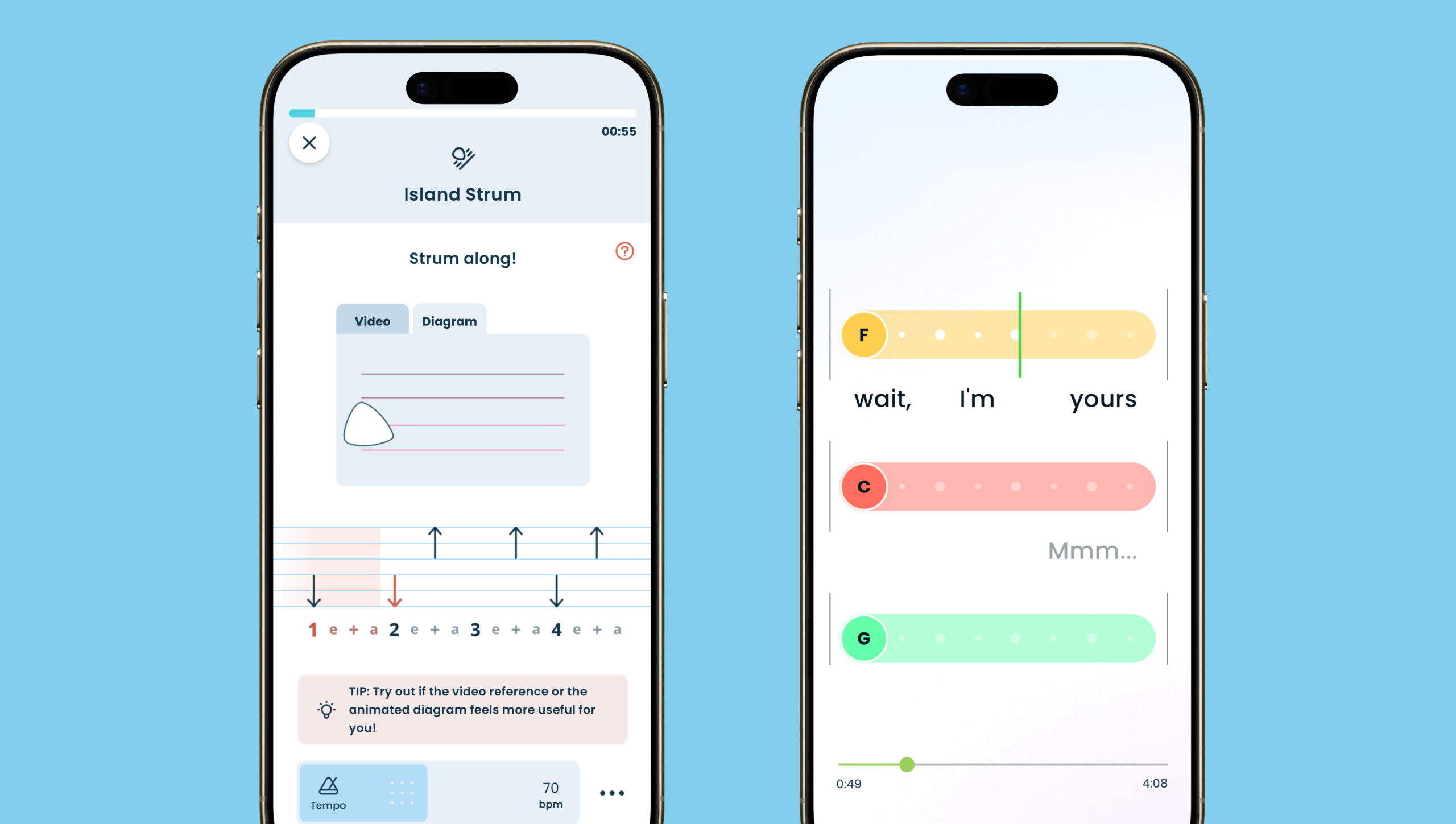
When you’re ready to connect the pattern to a real song, the Kala App‘s Strum Player shows the suggested pattern for each song in the library in D-U notation and lets you slow the tempo right down. If a section feels too fast, the tempo slider drops the speed without changing the pitch, so the song still sounds like itself, just at a pace you can actually follow.
These tools take the guesswork out of finding where to start. The suggested pattern in the app is your jumping-off point, not a strict instruction — exactly in line with UkuLenny’s principle that the pattern is an example, not a rule. Once you have it under your fingers, you’ll naturally start shaping it into something that feels like yours. Ready to put it into practice? Try the Kala App and start playing songs you love today.
Now get out there and strum something. Uke on.