
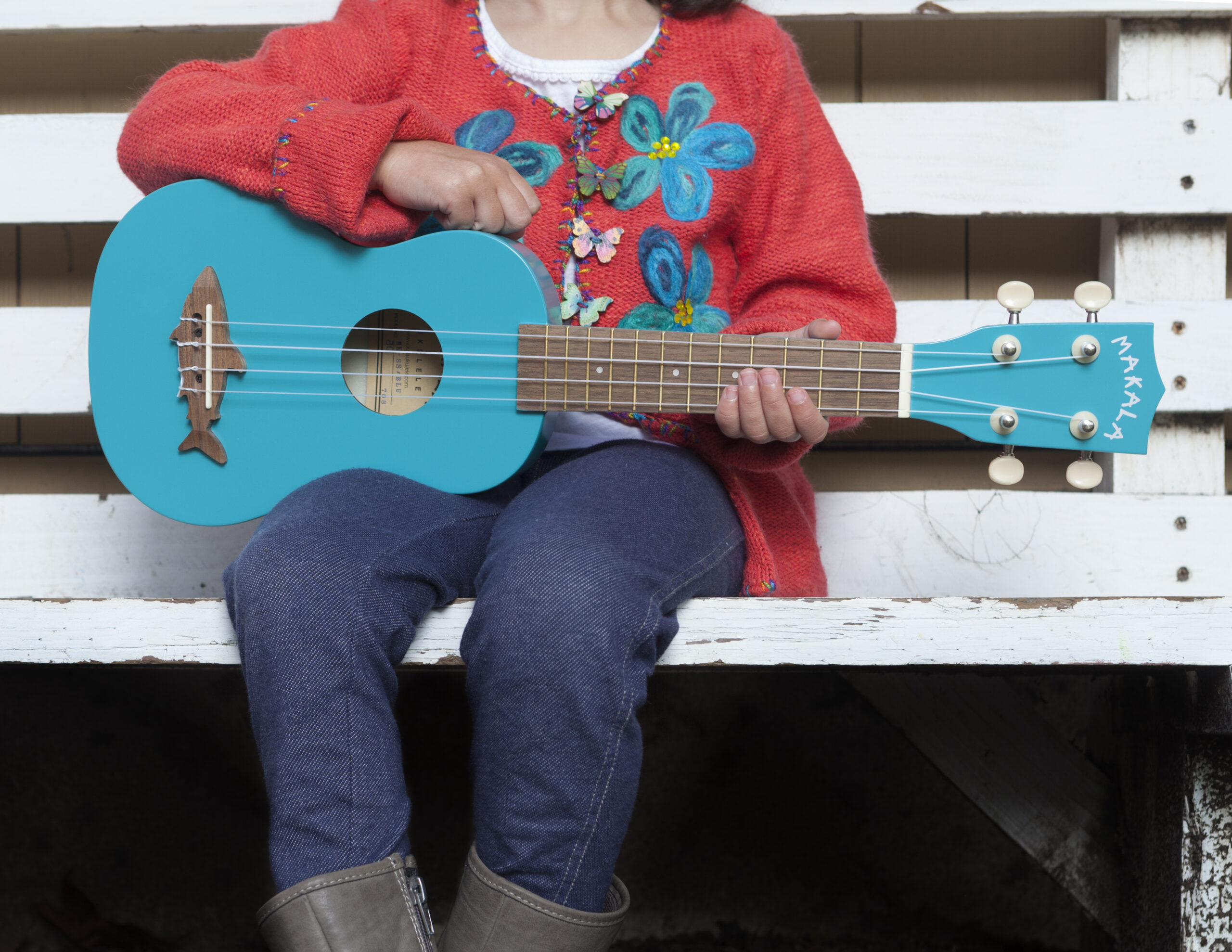
To play in 3/4 time on ukulele, you count three beats per measure instead of four, and your strumming pattern is built around that three-beat cycle. The most common approach is a simple down-down-down pattern, with a slight accent on beat one to give the music its characteristic waltz feel. The sections below cover everything from reading the time signature to choosing songs and understanding how 3/4 differs from its close cousin, 6/8.
What does 3/4 time actually mean for ukulele players?
In 3/4 time, each measure contains three beats, and a quarter note gets one beat. Instead of counting 1-2-3-4 as you would in most pop songs, you count 1-2-3, 1-2-3. The “1” carries a natural accent, which is what gives waltz-time music its lilting, rolling feel. For ukulele players, this simply means your strumming pattern resets every three beats rather than every four.
The top number in a time signature tells you how many beats are in each measure. The bottom number tells you what kind of note gets one beat. So in 3/4, the “3” means three beats per measure, and the “4” means a quarter note fills one of those beats. You don’t need to memorize music theory to use this in practice — just know that when a song is in 3/4, your internal count is always 1-2-3, and beat one is always slightly stronger than beats two and three.
Most popular songs are in 4/4 time, so 3/4 can feel a little unfamiliar at first. Think of it like a waltz: ONE-two-three, ONE-two-three. If you’ve ever watched ballroom dancing, that swaying, three-step rhythm is exactly what you’re counting. The easiest way to hear it is to count along to “Happy Birthday” — you’ll notice the natural emphasis falls every three beats, not four. That’s 3/4 in action. It’s worth being honest here: waltz time is less common in pop and rock, so you may not use it every day. But recognizing it and being able to play in it is an essential skill, and once it’s in your body, it never leaves.
What is the standard waltz strumming pattern on ukulele?
The standard waltz strumming pattern on ukulele is D-D-D, one downstroke on each of the three beats in the measure. Beat one gets a slightly louder strum to mark the start of the cycle. This three-beat pattern is the foundation of all waltz-style playing and works on any song in 3/4 time.
[VIDEO NEEDED]
Once the basic pattern feels comfortable, you can add texture with extended versions: D-DU-DU or D-D-DU per measure. These bring upstrokes into beats two and three, giving the rhythm more movement and a livelier feel without changing the underlying three-beat structure.
A few things to keep in mind as you build the pattern:
- Keep your hand moving. Even in 3/4 time, the strumming hand should never stop between beats. Think of it like a pendulum — down and up, down and up, continuously. When you play a downstroke on each beat, the upward motion still happens between beats; it just doesn’t hit the strings. That continuous motion is what keeps your timing steady.
- Accent beat one. A slightly firmer strum on the first beat of each measure is what makes the waltz feel like a waltz. Without it, the pattern sounds flat and even. ONE-two-three, ONE-two-three — that first beat should always be the strongest.
- Use your wrist, not your elbow. The motion should come from a relaxed wrist hinge. If your whole arm is moving, shake it out and start again with just the wrist.
[IMAGE — HAND POSITION]
How do you practice 3/4 strumming patterns as a beginner?
Start by muting all the strings — lay your fretting hand flat across the fretboard — and practice the D-D-D pattern without worrying about chords at all. Count out loud: 1-2-3, 1-2-3. This isolates the strumming motion and lets your hand build the three-beat rhythm before you add any chord complexity.
Once the rhythm feels natural with muted strings, add a single chord. C is the friendliest starting point. Strum D-D-D on that one chord until the count is automatic. Then introduce a second chord and practice switching between them while keeping the waltz pattern going.
[IMAGE — CHORD DIAGRAM]
Here’s a simple practice sequence that works well:
- Muted strings only — strum D-D-D and count aloud for two minutes.
- One chord — strum C (or Am) and hold it for four measures using D-D-D.
- Two chords — switch between C and Am every four measures, keeping the pattern going through the change.
- Extend the pattern — try D-DU-DU or D-D-DU once the basic version feels solid.
If your chord changes are making the rhythm collapse, that’s completely normal. Use the open strum trick: lift all your fingers just before the change so you strum an open chord for one beat. An open strum sounds far better than a late, messy chord change, and it keeps the rhythm intact while your fingers find their new position.
If you’re using the Kala App, the Strum Player breaks down the pattern and lets you slow the tempo right down — which is exactly the right approach when you’re first building the waltz feel. Start at 60% speed, get it clean, then nudge it up.
Which ukulele songs use 3/4 or waltz time?
Waltz time is less common in pop and rock than 4/4, so the list of well-known songs in 3/4 is shorter than you might expect. That’s worth knowing upfront — you’re not going to encounter it in every session, but when you do, you’ll be ready. “Happy Birthday” is the most recognizable example; its three-beat rhythm is instantly familiar, which makes it useful for internalizing the feel of 3/4 before applying it to less familiar songs.
One of the best songs for practicing 3/4 on ukulele is “Time in a Bottle” by Jim Croce. It’s in the key of Dm and stays in pure 3/4 throughout — acoustic, unhurried, and one of the most naturally waltz-feel songs available. The verse chords (Dm-Dm/C-Dm/B-Bb-Gm-Gm/C-C7) are complex shapes, so don’t start here if you’re a complete beginner. But the three-beat feel is unmistakably clear, and once you can feel that ONE-two-three pulse underneath the song, your understanding of waltz time will click into place. Use the Kala App and slow the tempo down significantly when you first try it.
Other songs commonly associated with 3/4 or waltz time include:
- “Take Me Out to the Ball Game” — a classic waltz-time song with a straightforward chord progression [VERIFY beginner chord set]
- “My Favorite Things” from The Sound of Music — unmistakably waltz-feel, recognizable to most players [VERIFY chords]
- “Norwegian Wood” by the Beatles — uses a 3/4 feel in sections [VERIFY]
- “Scarborough Fair” — a traditional folk song in 3/4 with a gentle, flowing character [VERIFY chords]
It can also help to contrast 3/4 with a song you already know in 4/4. “Redemption Song” by Bob Marley (key of G, chords G-Em-C-D-Am) is primarily in 4/4, but its flowing, unhurried feel makes it a useful comparison point. Play a verse of “Redemption Song” and count 1-2-3-4. Then switch to “Happy Birthday” or “Time in a Bottle” and count 1-2-3. Hearing that shift — one fewer beat per measure, the pattern cycling faster — is one of the clearest ways to understand what 3/4 actually feels like in practice.
When you’re browsing the Kala App‘s library of 2,000+ songs, listen to the backing track first and count along before you start playing. If your count naturally falls into groups of three, the song is in 3/4. The song’s suggested strumming pattern is a useful starting point, but treat it as an example to inspire your own approach rather than a rule to follow exactly.
How is 3/4 time different from 6/8 time on ukulele?
The key difference between 3/4 and 6/8 on ukulele is how the beats are grouped and felt. In 3/4 time, there are three quarter-note beats per measure, and you feel it as ONE-two-three. In 6/8 time, there are six eighth-note beats per measure, typically felt as two groups of three — ONE-two-three-FOUR-five-six — which gives it a faster, more flowing pulse. Both have a “three-feel,” but 6/8 moves with more momentum.
In practical terms for strumming:
- 3/4 feels like a traditional waltz — steady, measured, one strong beat followed by two lighter ones. Pattern: D-D-D per measure.
- 6/8 feels like a faster waltz or a rolling gallop — two accented beats per measure, each with three subdivisions underneath. Pattern: D-D-D-D-D-D, or a more musical D——D-U—D-U.
[VIDEO NEEDED]
A useful way to hear the difference: “Happy Birthday” is in 3/4 and feels like a gentle, even waltz. Many Irish folk songs and sea shanties are in 6/8 and have that rolling, forward-driving energy. Both time signatures share the three-subdivision feel, but 6/8 has two of those groups per measure instead of one.
For beginners, 3/4 is the better starting point. The three-beat count is simpler to internalize, and the D-D-D pattern is easy to build on. Once the waltz feel is in your body, 6/8 will make sense almost immediately — it’s just 3/4 doubled up and accelerated. Try the Kala App to practice both feels with real songs and guided strumming patterns.
Now go find a song in 3/4, count yourself in, and let that waltz pattern roll. You’ve got this.