
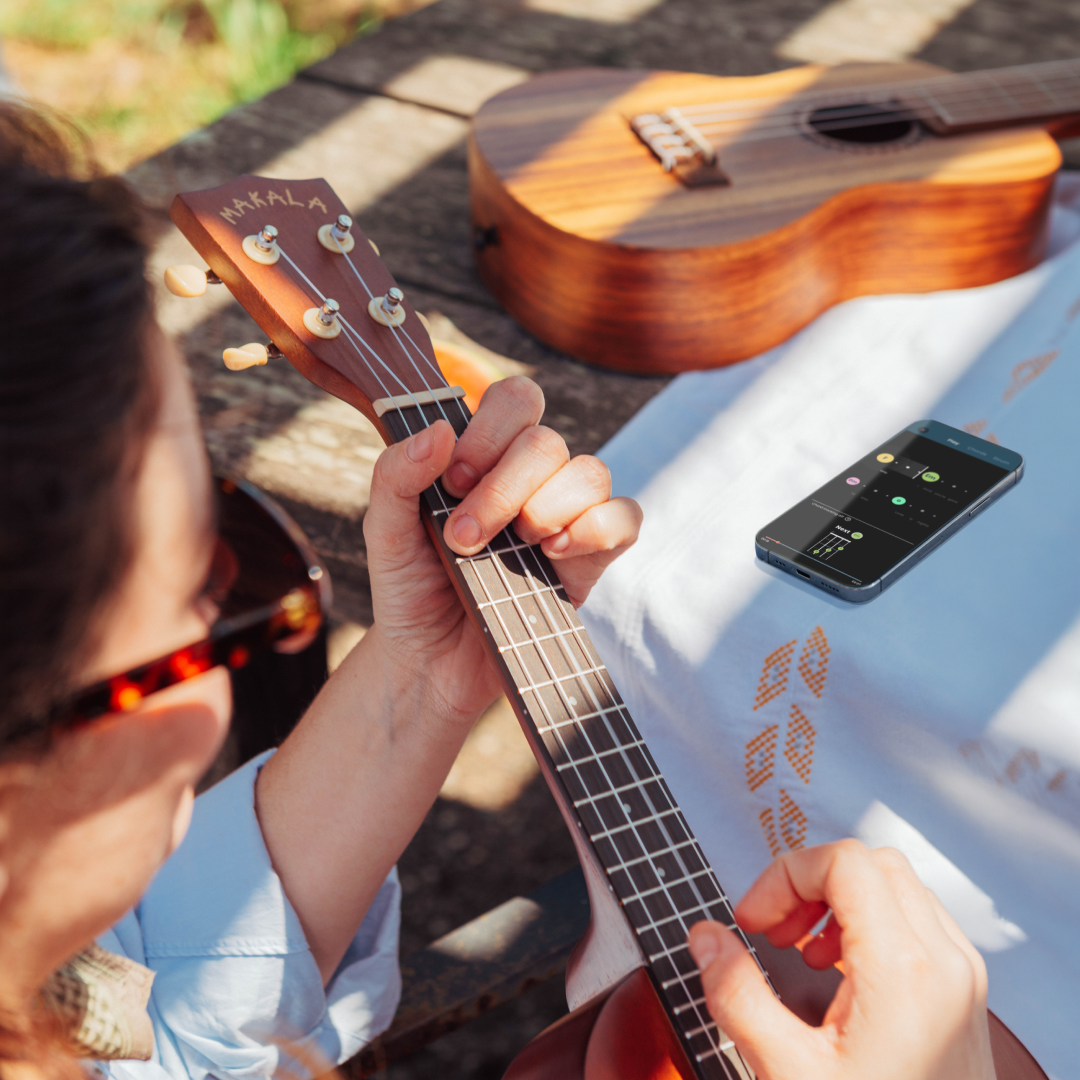
To count beats on ukulele, listen for the steady pulse running through the music and count along with it: one, two, three, four, one, two, three, four. That pulse is the beat. Every strum you play lands on or between those numbers, and keeping track of where you are in that count is what ukulele timing is all about. The sections below break down the most common beginner questions on rhythm, time signatures, and why the beat sometimes disappears mid-song.
[IMAGE]
What does it mean to count beats in music?
Counting beats in music means tracking the steady, repeating pulse that holds a song together. Think of it like a heartbeat; it runs underneath everything, whether or not you can hear it explicitly. In most songs, beats are grouped into measures of four, and you count through each measure by saying: one, two, three, four. That cycle repeats from the first note to the last.
Each number in that count is one beat. The space between beats, the “and,” divides each beat in half. So the full count of a measure sounds like: one and two and three and four and. This is the foundation of all ukulele rhythm. Downstrokes land on the numbers. Upstrokes land on the “ands.” Once you can feel that grid in your body, everything else, strumming patterns, chord changes, timing, starts to make sense.
Beats are not the same as notes. A song might have lots of notes crammed into a single beat, or it might hold one note across several beats. The beat itself never changes speed. It just keeps going, like a clock ticking in the background.
How do you count beats while playing ukulele?
To count beats while playing ukulele, say the numbers out loud, one, two, three, four, at a steady pace while you strum. Start by strumming down on every number and nothing else. This is the simplest possible approach, and it works. Once that feels natural, add the “ands” between each beat and try an upstroke on each one.
[VIDEO NEEDED]
Here is the key principle: your strumming hand should never stop moving. Think of it like a pendulum swinging down and up, down and up, at a perfectly even pace. The numbers are the downswings; the “ands” are the upswings. Whether or not your hand actually hits the strings on a given swing, the motion continues. This is what keeps your timing consistent. If the hand stops between strums, the rhythm collapses.
A practical way to build this habit is to mute the strings first. Lay your fretting hand flat across all four strings so they produce a soft thud instead of a chord. Then strum in a steady down-up motion and count aloud. You are training the motion before adding the complexity of chord shapes. Once the pendulum feel is in your body, reintroduce the chords.
Nodding your head to the beat helps too. Your body already understands pulse; it just needs a way to express it. Once you are nodding and strumming at the same time without counting numbers consciously, you have internalized the beat.
What are the most common time signatures for ukulele songs?
The most common time signature for ukulele songs is 4/4, which means four beats per measure. The vast majority of pop, rock, folk, and country songs use it. The second most common is 3/4, which has three beats per measure and gives songs a waltz-like feel. A smaller number of songs use 6/8, which groups six beats into two sets of three and has a rolling, lilting quality.
In 4/4 time, you count: one, two, three, four, then repeat. This is the default for most of what you will learn on ukulele. Songs like “Somewhere Over the Rainbow” and most chart pop tracks live here.
In 3/4 time, you count: one, two, three, then repeat. “Happy Birthday” is the classic example. The strum pattern is simpler, often just three downstrokes per measure, but the count feels different at first because you are always starting a new measure on three instead of four.
In 6/8 time, you count: one, two, three, four, five, six. It often feels like two groups of three rather than six individual beats, and it shows up in folk songs and ballads. Once you can feel the difference between 4/4 and 3/4, 6/8 becomes easier to recognize by ear.
When you pick up a new song, tap your finger along to the recording and count. If you naturally reach four before the next strong beat, it is 4/4. If you reach three, it is 3/4. That tap-and-count method works for almost every song a beginner will encounter. If you want guided help identifying time signatures in real songs, the Kala App walks you through real tracks step by step.
Why do beginners lose the beat when switching chords?
Beginners lose the beat when switching chords because the chord change demands conscious attention, and the moment attention shifts to the fretting hand, the strumming hand slows down or stops. The rhythm collapses not because the strummer forgot the beat, but because two tasks are competing for the same mental bandwidth at the same time.
This is one of the most common frustrations in early ukulele learning, and it is completely normal. The fix is not to think harder; it is to make the chord change more automatic so it stops requiring conscious thought.
Two techniques help most:
- The open strum trick: Just before a chord change, lift all your fingers off the strings for a split second. An open strum, all strings ringing freely, sounds far better than a late, buzzy chord landing after the beat. It keeps the rhythm intact while you get your fingers into position.
- Slow practice with a metronome or backing track: Practice the chord transition at a tempo where you can complete the change cleanly before the next beat arrives. Speed comes with repetition. Trying to match full song tempo before the transition is automatic is the single most common cause of beginner frustration.
The Kala App’s tempo slider lets you slow a song to whatever speed feels manageable, 60%, 50%, even slower, without changing the pitch. Slow the track down, get the chord change clean, then gradually bring the speed back up. The beat stays steady when the change stops being a scramble. Try the Kala App and use the tempo slider on your next tricky chord change.
How does a metronome help with ukulele timing?
A metronome helps with ukulele timing by providing an external, unwavering pulse to play against. Unlike playing along to a song, where you might unconsciously speed up or slow down to match your own mistakes, a metronome holds the tempo exactly. It reveals the moments where your timing drifts, which is the first step to fixing them.
Start at a tempo that feels almost too slow. Set the metronome to something like 60 beats per minute and strum one downstroke on each click. The goal is not to match the click; it is to land with it, cleanly and consistently. If you are landing slightly before or after the click, you can hear it immediately.
Once single downstrokes feel locked in, add the upstrokes on the “ands” between clicks. Then try chord changes. The metronome does not care if you miss a chord; it keeps clicking, and that is exactly the point. You learn to keep the rhythm going even when a chord change goes wrong, which is the same skill you need when playing a real song.
A metronome also builds what players call an internal clock, a felt sense of steady pulse that eventually runs on its own, without needing to count out loud. Most experienced players no longer count consciously; they feel the beat in their body. A metronome is the tool that builds that feeling over time. Even a few minutes of slow, deliberate metronome practice each session makes a noticeable difference within weeks.
So here is the thing: timing is a skill, not a talent. It gets better with practice, and a metronome is the most honest practice partner you will find. If you want a built-in metronome alongside lessons, chord libraries, and real songs, start learning with the Kala App today. Uke on.