

If you have just picked up a ukulele for the first time, here is the best news you will hear today: you can play a real, recognisable song with a single chord. No complicated fingering. No chord changes. Just one shape, a strum, and music coming out of your instrument. That is not a beginner shortcut — it is a genuinely great place to start.
One-chord strum exercises let you focus on the things that actually matter in your first sessions: getting a clean sound, finding a strumming rhythm, and building the muscle memory that makes everything else easier later. By the end of this guide, you will have played your first complete song all the way through.
The best songs to use as one-chord strum practice
True one-chord songs are rare, and most of the tracks you love use at least three or four chords in full. But that does not matter yet. The best way to start is to pick a well-known song and strum a single chord all the way through it — not because that is how the song is played, but because it gives you something familiar to lock your rhythm to while your strumming hand finds its natural motion. Think of it as a training exercise, not a performance.
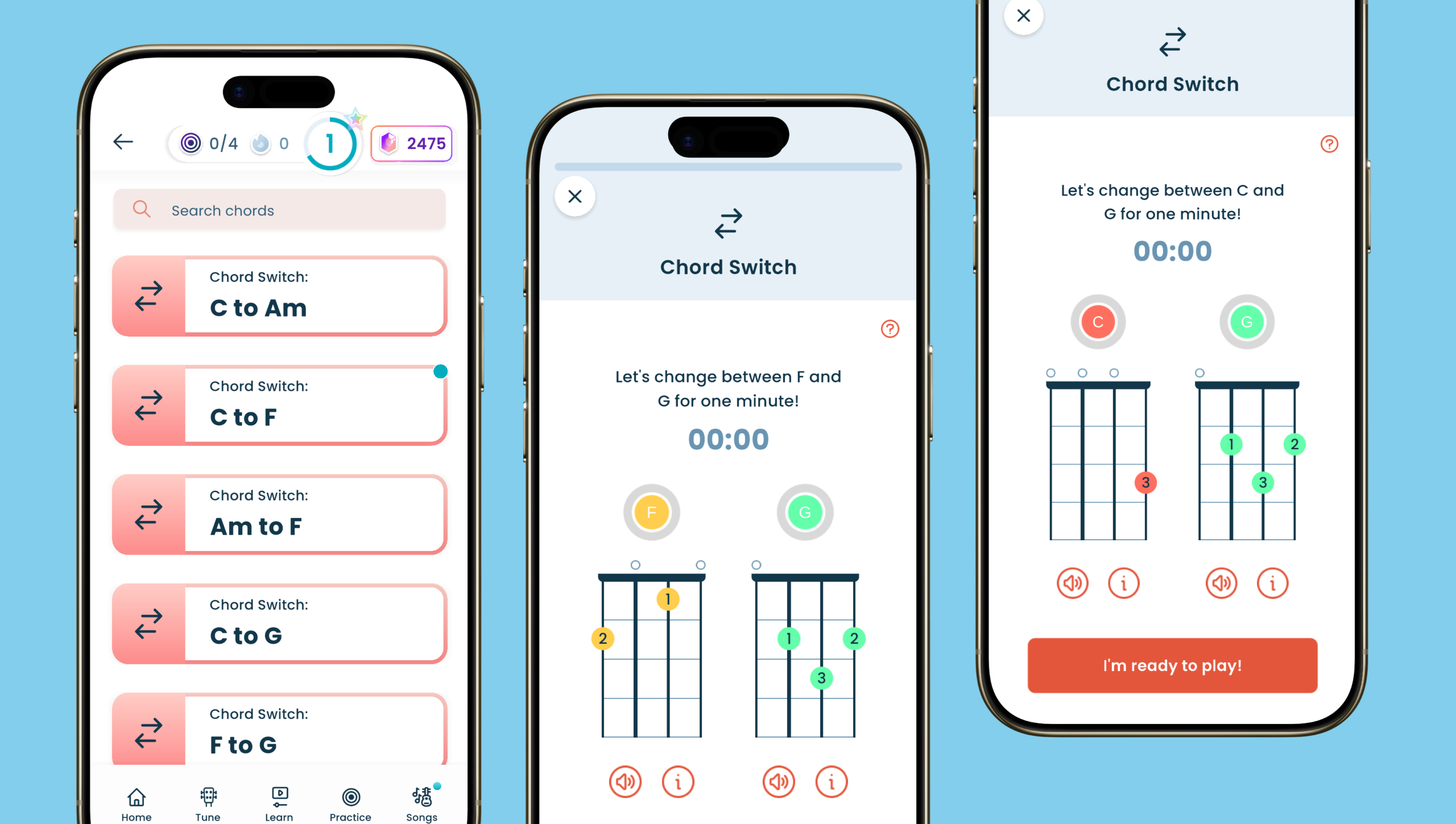
The two chords that unlock this approach for absolute beginners are C major and A minor.
Both chords use just one finger — which you will see in the chord diagrams. Press it down, strum all four strings, and that is your first chord.
Here are three songs that work brilliantly as single-chord strum exercises at the day-one stage.
Have You Ever Seen the Rain — Creedence Clearwater Revival
Have You Ever Seen the Rain” is the cleanest possible introduction to the four magic chords: C, G, Am, and F. Those four shapes together unlock an enormous portion of the rock catalog, and this song uses them in a way that’s predictable and regular — the changes come exactly where you expect them, which makes it ideal for building muscle memory.
It sits in the key of C and runs at around 116 BPM, which is a comfortable mid-tempo.
Don´t worry about the strumming pattern, or other chords yet. Just start playing the C chord when you see in on the app screen, and when you are ready for it, play the Am Chord also.
Mustang Sally -Wilson Picket
Mustang Sally brings the energy up another level. The simplified chord set for ukulele is C,F and G — three chords wich are largely used in the beginner songs. But let´s start now with the C chord only.
If you want to try to strum with the C chord only through the song, you can play Mustand Sally with the Easy Island Strum pattern D–D–DU-UD. That pattern gives it the high-energy, propulsive feel that makes the song so satisfying to play. Once the strum locks in, the song almost plays itself — the momentum carries you forward.
The way to get there is to practise the strum motion independently — just the hand, no chords — until it becomes automatic. Then add the chords one at a time. Use the Kala App’s tempo slider to start slow and build up gradually. When it finally comes together at full speed, it’s one of the most satisfying moments in beginner rock ukulele. That’s why it belongs at the end of this list: not because it’s impossibly hard, but because it rewards everything you’ve built along the way.
How to play your first chord cleanly
Getting a clean C chord is mostly about two things: where your finger lands, and how curved your knuckle is.
Press your third finger just behind the third fret — not on top of the metal bar, but in the space between the second and third frets, close to the third. Think of it like pressing a button all the way down. If you place your finger too far back in the fret space, the string will buzz instead of ringing. That buzzing is normal at first — a small adjustment in finger position usually sorts it.
Keep your knuckle bent. A flat finger accidentally leans on the strings next to it and mutes them. A bent knuckle keeps your fingertip upright and lets the other strings ring freely. Strum slowly and listen to each string individually. If one sounds dull or dead, check that your finger is not touching it.
This one can feel a little awkward at first — your hand is not used to holding this shape. That passes faster than you would expect. A few minutes of pressing, strumming, and listening is all it takes before the chord starts to click.
Simple strumming patterns that work for every song
Before worrying about patterns, get comfortable with a single downstroke. Think of your strumming hand like a paintbrush sweeping lightly across the strings — a loose wrist, not a stiff arm. The sound should be smooth and even, not scratchy or uneven.
Once that feels natural, try the most beginner-friendly pattern: four steady downstrokes per bar, one on each beat. It sounds simple because it is, and it works over almost any song.
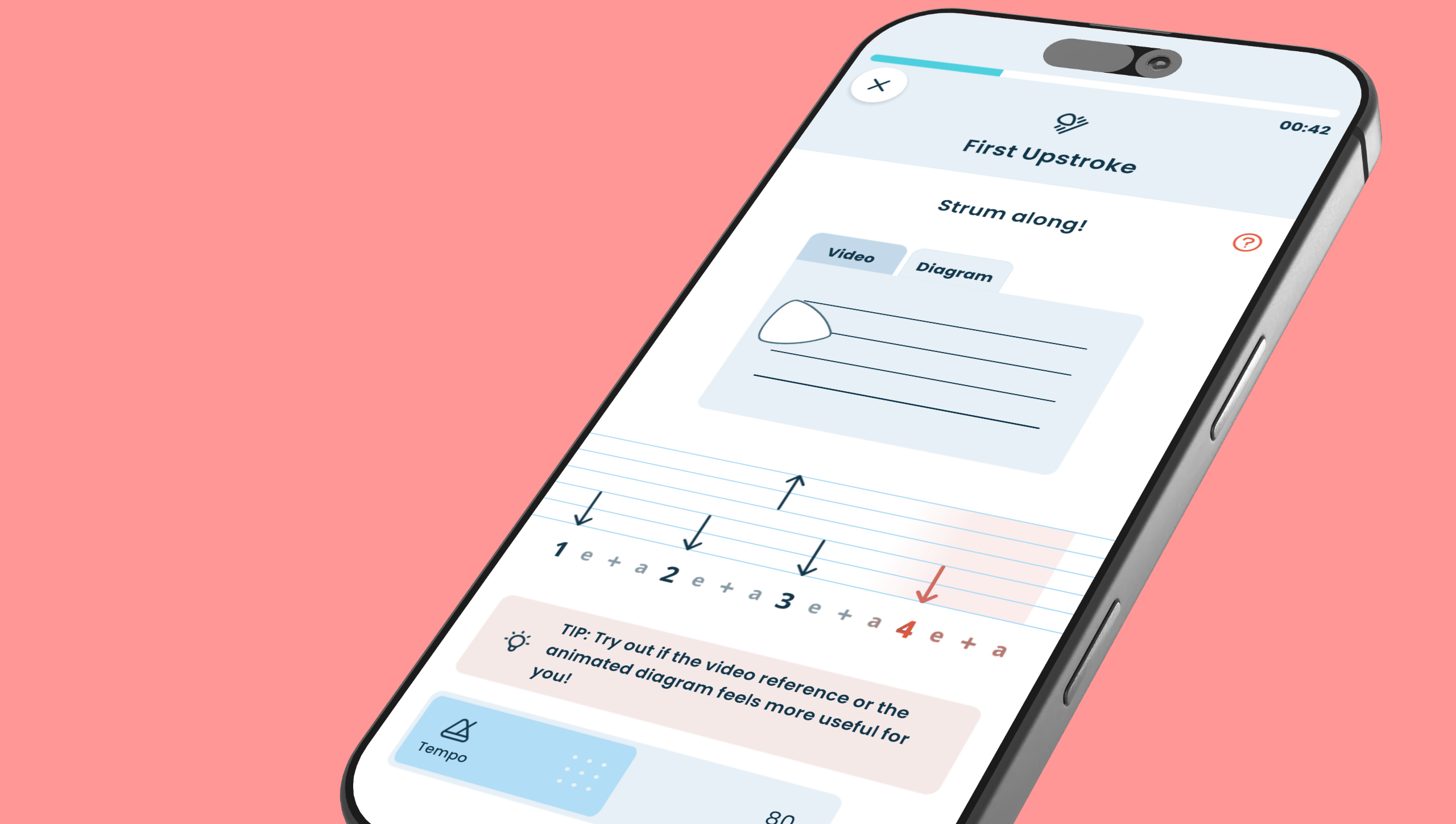
When that feels comfortable, add a single upstroke after the last downstroke. So the pattern becomes: down, down, down, down-up. The upstroke is lighter — your fingers brush back up across the strings the way you might flick water off your hand. Do not force it. Let the wrist do the work.
The key here is keeping the rhythm steady. A slightly rough chord sounds far better in time than a perfect chord that stops the music. If the strum wobbles, slow it right down until it feels automatic, then gradually bring the tempo back up. The Kala App’s tempo slider lets you slow a backing track to whatever speed feels manageable — use it.
What to practice once the song feels easy
When a one-chord strum exercise starts to feel comfortable, that is not the end — it is the signal to add the next layer. For “Have You Ever Seen The Rain” the most natural step is to introduce a second chord. A minor (Am) sits right next to C, and the transition between C and Am is one of the smoothest to learn.
You can also use the chord filter in Kala Ukulele App song selection to Filter Songs with C and Am – there are many!

Start by switching slowly between your two chords without any strumming at all. Just press one shape, lift, press the other, lift. Like musical chairs — keep your eye on where the next shape lands, and move when the moment comes. Once the switch feels automatic, add the strum back in.
You can also use the time to refine what you already have. Try playing the same song with a slightly more interesting strum pattern. Try playing it with your eyes closed. Try playing it a little faster, then a little slower. Going deeper into one song teaches you more than rushing to the next one.
When you are ready to find more songs to practise with, the Kala App’s song filter lets you search by chords you already know. Filter for C, and you will get a list of every song in the library that uses it — sorted so the simplest arrangements sit at the top. It is a direct way to turn one chord into a whole practice session’s worth of material, and the list grows quickly as you add new shapes.
The structured Learning Path in the Kala App, designed by UkuLenny and Kala’s teaching team, takes you through exactly this progression — one solid step at a time, so nothing feels like a jump. You will not suddenly find yourself stuck because you skipped something important.
Now get out there and strum. You have got a chord, you have got a song, and that is all you need to start. Uke on.