

You do not need a pick to strum a ukulele. In fact, most ukulele players never use one. The ukulele is designed to be played with the fingers – the soft flesh and nails of your hand produce a warmer, rounder tone than a plastic pick, which can sound harsh and bright on nylon strings. The questions below cover everything a beginner needs to know about strumming with their fingers, from hand position to common problems and how to fix them.
Do you need a pick to play the ukulele?
No, you do not need a pick to play the ukulele. Unlike the guitar, where picks are common, the ukulele is traditionally played fingerstyle. The instrument’s nylon strings respond beautifully to the natural texture of fingers and nails, producing a warm, mellow tone that a pick often works against rather than with.
Some players do experiment with felt picks, which are softer than standard guitar picks and sit somewhere between a fingertip and a hard plectrum in terms of tone. But for most beginners learning how to strum a ukulele without a pick, fingers are the right starting point. You always have them with you, they give you more dynamic control, and they are exactly what the instrument was designed for.
The good news is that strumming with your fingers is not harder than using a pick – it just feels unfamiliar for the first few sessions. That passes faster than you might expect.
Which finger should you use to strum a ukulele?
The index finger is the most common choice for strumming a ukulele, and it is the best starting point for beginners. On the downstroke, the nail side of the index finger sweeps across the strings. On the upstroke, the fleshy pad of the same finger brushes back up. This combination gives a natural, balanced tone in both directions of the stroke.
The thumb is the other main option. Strumming with the thumb produces a softer, rounder sound and is popular in folk and traditional playing styles. Some players use the thumb for slow, gentle songs and switch to the index finger when they want a crisper, more defined strum.
As you develop your technique, you may start combining fingers – using the index finger for downstrokes and the thumb for upstrokes, or incorporating the middle and ring fingers for fingerpicking patterns. But when you are starting out, commit to the index finger. It is the most versatile choice and the foundation everything else builds on.
How do you hold your hand when strumming without a pick?
When strumming a ukulele with fingers, the motion should come from your wrist, not your elbow or shoulder. Hold your strumming hand loosely over the strings, roughly above the point where the neck meets the body. Your fingers should be relaxed and slightly curved – not stiff, not fully open. Think of it like shaking water off your hand, but in a controlled, rhythmic arc.
A loose wrist is everything here. If your wrist locks up, the strum becomes stiff and mechanical. The wrist acts as a hinge, swinging the finger down through the strings on the downstroke and back up on the upstroke. The whole motion is small and fluid, not a big sweeping arm movement.
On the downstroke, let the nail of your index finger lead. On the upstroke, the fleshy pad of the finger comes back through. Keep your thumb tucked loosely or extended slightly – whatever feels natural and does not create tension in the hand.

If your hand feels tense, stop and shake it out. Then try again with a lighter touch. The strings only need gentle contact to vibrate – pressing harder does not make the sound louder, it just tightens everything up and makes the strum sound choppy.
What are the basic strumming patterns for ukulele beginners?
The best starting point for ukulele strumming patterns is a simple down strum on every beat. In 4/4 time – the most common time signature in popular music – that means strumming down on beats 1, 2, 3, and 4. Once that feels steady, you add an upstroke between each beat, creating a continuous down-up motion that forms the foundation of almost every pattern you will ever use.
Here are the three patterns worth learning first, in order:
- Down on every beat (D-D-D-D): The absolute beginner starting point. Strum down on 1, 2, 3, 4. Nothing more. This builds your internal clock and gets sound out of the instrument straight away.
- Down-up on every beat (D-U-D-U-D-U-D-U): Add an upstroke after each downstroke. Count: 1-and-2-and-3-and-4-and. The hand moves continuously, which is exactly what it should always be doing.
- The Island Strum (D-D-U-U-D-U): The most iconic ukulele strumming pattern. It has a deliberate gap in the middle – a missed downstroke where the hand keeps moving through the air without hitting the strings. This is the one that trips most beginners up, and it is worth taking slowly.
You can start from the “thumb only strumming style”.
The single most important principle across all of these patterns is that the hand never stops moving. Whether you are hitting the strings or not, the hand keeps swinging down and up like a pendulum. When you “miss” a strum deliberately, the hand still travels through the air in the same rhythm. This is what keeps the timing consistent. If the hand stops between strums, the pattern falls apart.
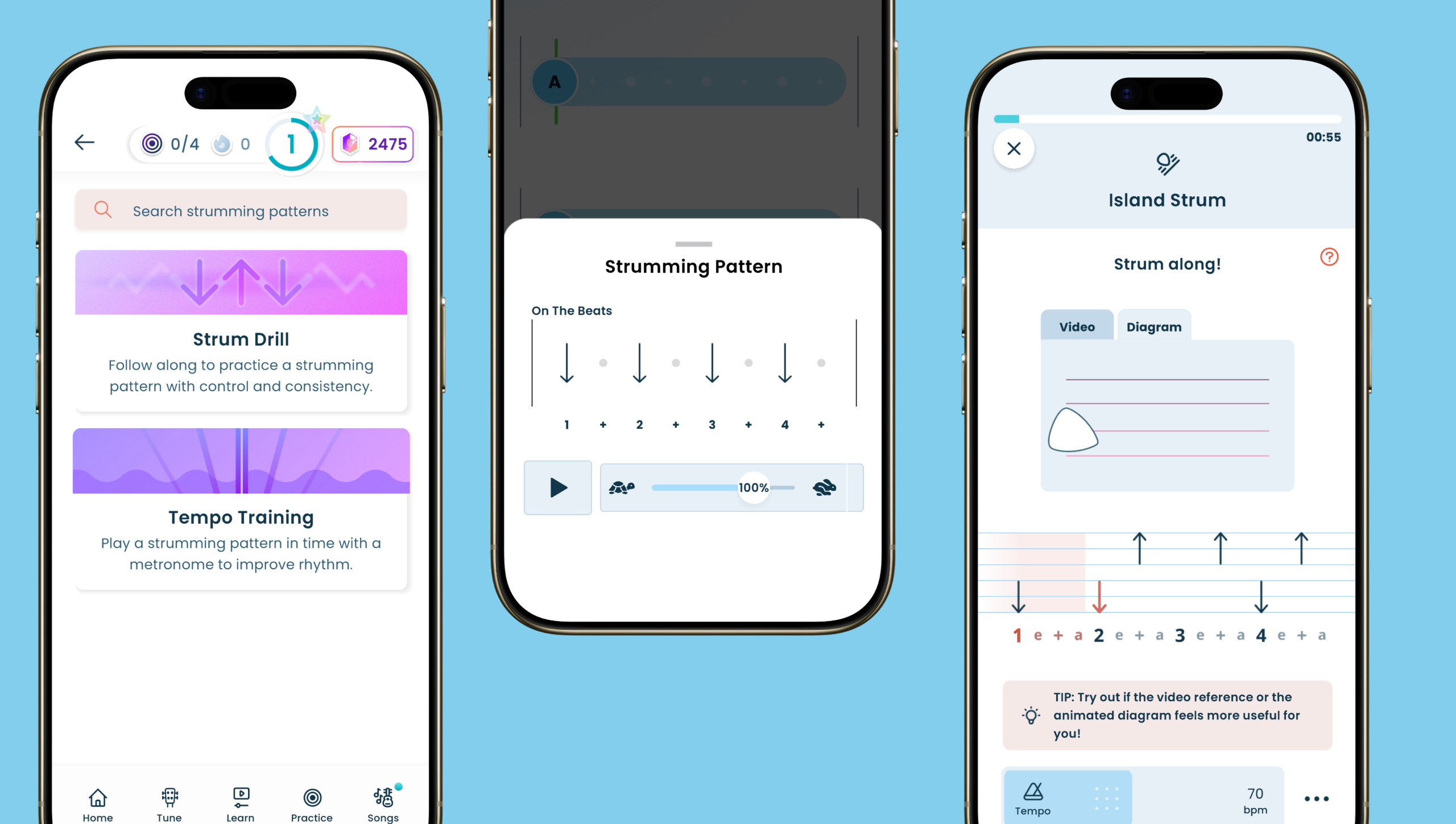
The Kala App‘s Strum Player breaks each of these patterns down visually and lets you slow the tempo right down so you can see and hear exactly what is happening before you try to match a full song’s speed.
Why does my ukulele strumming sound uneven or buzzy?
Uneven or buzzy strumming on a ukulele is almost always caused by one of a handful of fixable problems, and most of them are not actually about the strumming hand at all. The most common culprit is a late or incomplete chord change – when the fretting hand is not fully in position before the strum lands, the strings buzz or mute instead of ringing cleanly.
Here are the most common causes and what to do about each:
- Chord change is late: The fretting hand is not ready when the strum arrives. Practice switching between two chords at a very slow tempo until the change feels automatic before adding speed. You can also use an open strum – lift all fingers just before the change – which sounds cleaner than a late chord and is a real technique, not a cheat.
- Wrist is stiff: A locked wrist makes the strum jerky and uneven. Shake out your hand, then strum again with a looser grip. The motion should feel fluid, not forced.
- Hand stops between strums: If the strumming hand pauses between strokes, the rhythm collapses and the sound becomes choppy. Practice with your fretting hand flat across all strings (muting them completely) and keep the strumming hand moving continuously even when it is not hitting the strings. This isolates the strumming motion and trains the hand to keep going.
- Pressing too hard on the strings: Fingers pressing harder than needed cause buzz and muffled notes. A lighter, more precise touch on the frets usually solves it.
- Trying to match full song tempo too soon: Rushing to keep up with the original recording before the chord changes are clean is the most common cause of frustration. Slow everything down. The tempo slider in the Kala App lets you drop a song to 60% speed or lower – get it clean there first, then gradually bring the speed back up.
It might feel awkward at first, and that is completely normal. The buzzing and unevenness are not signs that you are doing it wrong – they are signs that you are at the exact right stage of learning. A small adjustment in finger position or tempo usually sorts it. Keep going, and it clicks faster than you’d expect.
Now get out there and strum. Try the Kala App to guide you through your first songs and strumming patterns at your own pace. Uke on.