
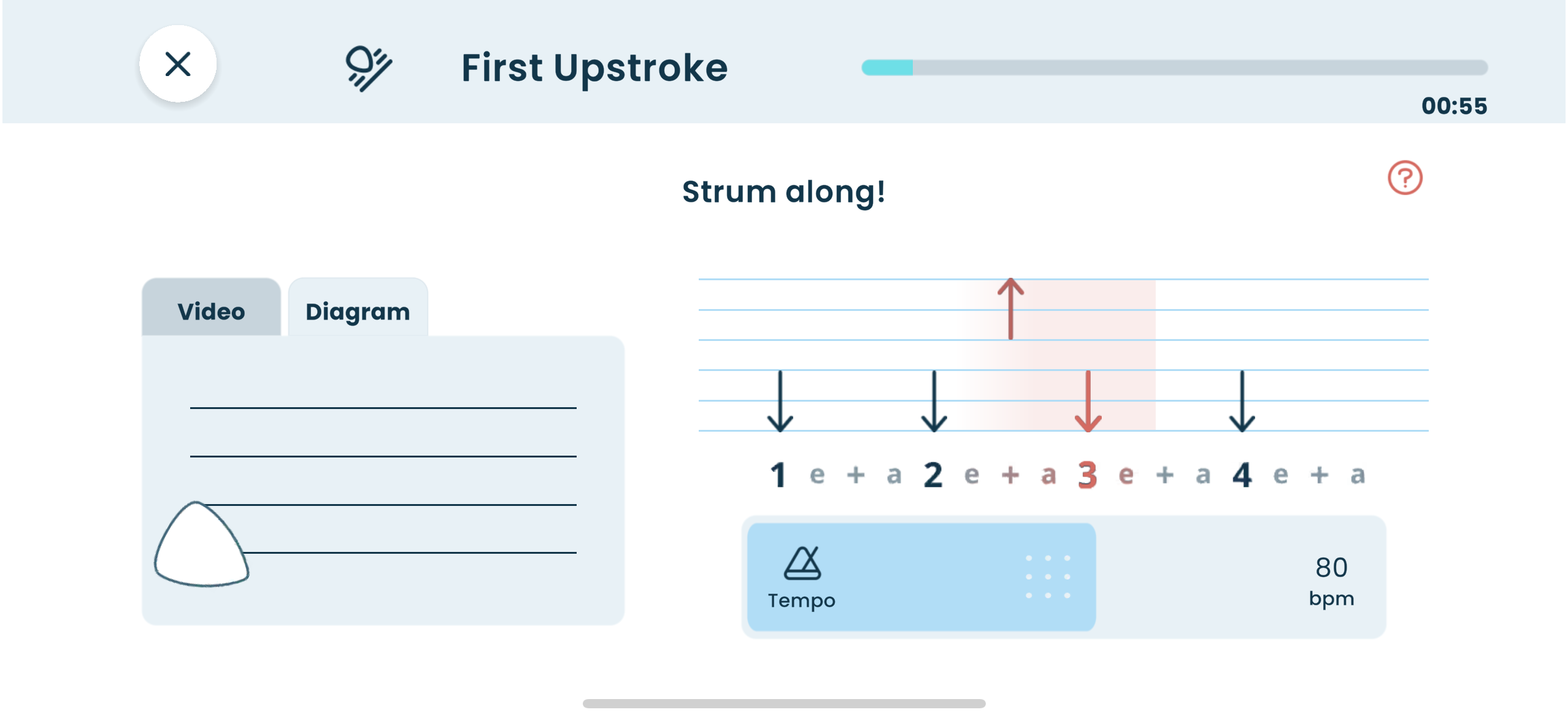
To strum a ukulele, sweep your index finger across all four strings in a smooth downward motion, nail side leading, using a relaxed wrist rather than your whole arm. That single motion is the foundation of everything. The fretting hand makes the chord shape; the strumming hand makes it sound like music. Below, you’ll find answers to the most common questions beginners have about strumming technique, rhythm, patterns, and chord changes.

What is strumming, and why does it matter separately from knowing chords?
Strumming is the rhythmic sweeping of your fingers or a pick across the ukulele strings to produce sound. It is entirely separate from chord knowledge, and that distinction matters more than most beginners realise. You can know every chord shape perfectly and still sound hesitant and choppy if your strumming hand has no rhythm. Equally, a player with a strong, confident strum can make even a simple one-chord song feel musical.
Think of it this way: the fretting hand determines which notes are available, but the strumming hand determines whether those notes sound like music or like an accident. Rhythm is what makes a song recognisable. A listener can identify Three Little Birds by Bob Marley from the strum pattern alone, even before a single chord is named.
This is why strumming deserves its own focused attention, separate from chord practice. The two skills develop on parallel tracks and come together once each is solid on its own.
The central principle: the hand never stops
The single most important principle in all of ukulele strumming is this: your strumming hand keeps moving continuously, like a pendulum, whether it hits the strings or not. This is not a tip or a shortcut — it is the entire foundation of strumming rhythm.
Most beginners stop their hand between strokes, and that pause is what collapses the timing. When your hand keeps moving through the air even on a “missed” strum, the rhythm stays locked in place. The hand never stops. Every pattern you will ever learn is built on that one rule.
If you take nothing else from this article, take that.
How do you count beats, and what does 4/4 mean?
Most ukulele songs are written in 4/4 time, which simply means there are four beats in every measure. You count them out loud as 1, 2, 3, 4, then start again. Each number is one beat, and together they form one bar of music.
When you add upstrokes to the pattern, you count the spaces between the beats as “and.” The full count becomes: 1 and 2 and 3 and 4 and. Downstrokes land on the numbers. Upstrokes land on the ands.
Here is how to feel this before you even pick up the ukulele:
- Tap your foot four times at a steady pace. That is one measure of 4/4.
- Now tap and say “1, 2, 3, 4” in time with your foot.
- Finally, add “and” between each tap: “1 and 2 and 3 and 4 and.”
That spoken count is the skeleton every strumming pattern hangs on. Once it lives in your body rather than just your head, adding strumming patterns becomes a matter of deciding which beats to hit and which to skip — not a matter of memorising sequences.
Down strum on every beat: learning with Three Little Birds
The simplest possible strumming pattern is a single downstroke on every beat: D-D-D-D. Strum down on beats 1, 2, 3, and 4, then repeat. Nothing more. This is the starting point for absolute beginners because it trains your internal clock and gets real sound out of the instrument immediately.
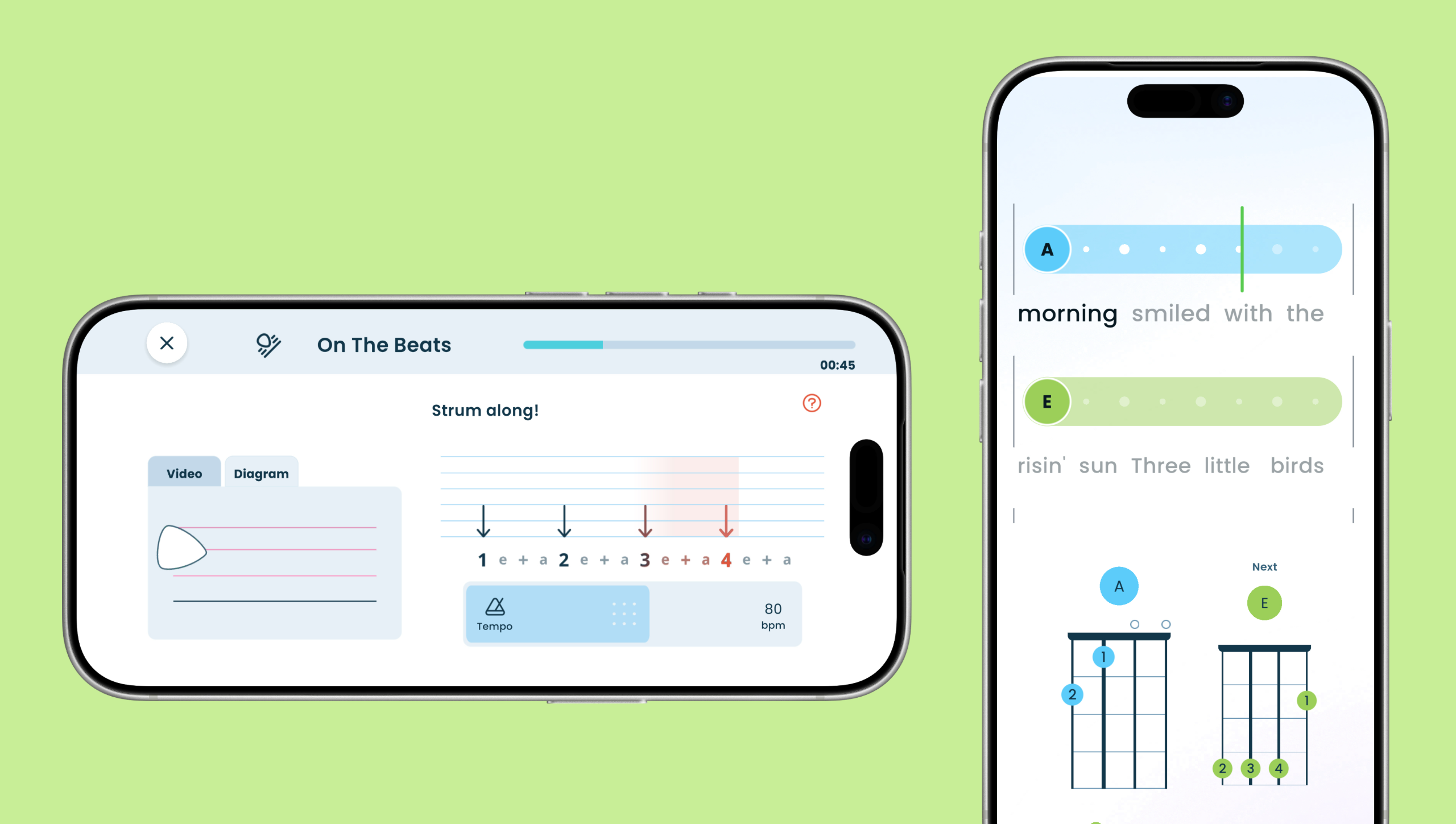
The best song to learn this pattern on is Three Little Birds by Bob Marley. It sits at around 74 BPM, making it one of the slowest and most forgiving songs you can choose. The chords are A, D, and E — three of the most common ukulele chords — and the laid-back reggae feel means a steady, unhurried downstroke sounds exactly right. You are not simplifying the song by strumming on every beat; you are playing it in the most natural way possible.
Practice the D-D-D-D pattern on a single chord first. Once it feels automatic, try switching between A and D while keeping the strum going. Do not stop the strum to change chords. Keep the hand moving and let the fingers catch up. That is the whole game.
Three Little Birds also introduces the reggae feel, which will become relevant later when you start choosing the right strum for a given song. For now, focus on the steadiness of the beat.
Adding upstrokes: the basic down-up pattern
Once the single downstroke feels automatic, add an upstroke after every downstroke. The pattern becomes D-U-D-U-D-U-D-U, counted as 1-and-2-and-3-and-4-and. Your hand is now doing exactly what it should always be doing: moving continuously.
The correct strumming hand position uses the index finger as the primary point of contact, with the nail side facing down on the downstroke and the flesh side facing up on the upstroke. The motion comes from the wrist, not the elbow or shoulder. Keep your hand relaxed and loose, hovering just over the soundhole.
Think of the wrist like a paintbrush or a windshield wiper. It hinges naturally, sweeping across the strings without tension. If you feel stiffness in your forearm, shake your hand out as if you’re flicking water off your fingers, then try again. That loose, floppy feeling is exactly right.
A few things to check when you’re getting started:
- Finger curl: Let the index finger curl slightly rather than pointing stiffly at the strings.
- Contact point: Strum across the strings near the soundhole, not over the frets.
- Pressure: Lighter than you think. The strings only need a gentle sweep to vibrate cleanly.
- Elbow: Keep it relatively still. If your whole arm is swinging, the motion is coming from the wrong place.
To practice the down-up pattern without worrying about chords, lay your fretting hand flat across all four strings to mute them and strum the pattern. This removes the chord complexity entirely and lets your strumming hand focus on the motion alone. Once the pendulum feel becomes automatic, add a chord shape and carry on.
The Easy Island Strum: learning with Yellow
The Easy Island Strum is the little easier version of the most iconic ukulele strumming pattern and the one most people picture when they think of the instrument. It works on dozens of popular songs, and once you have it, it opens up a huge amount of repertoire. The pattern includes a deliberate missed downstroke in the middle, which is what catches most beginners off guard.
Pattern: D-D-U–(miss)-U-D
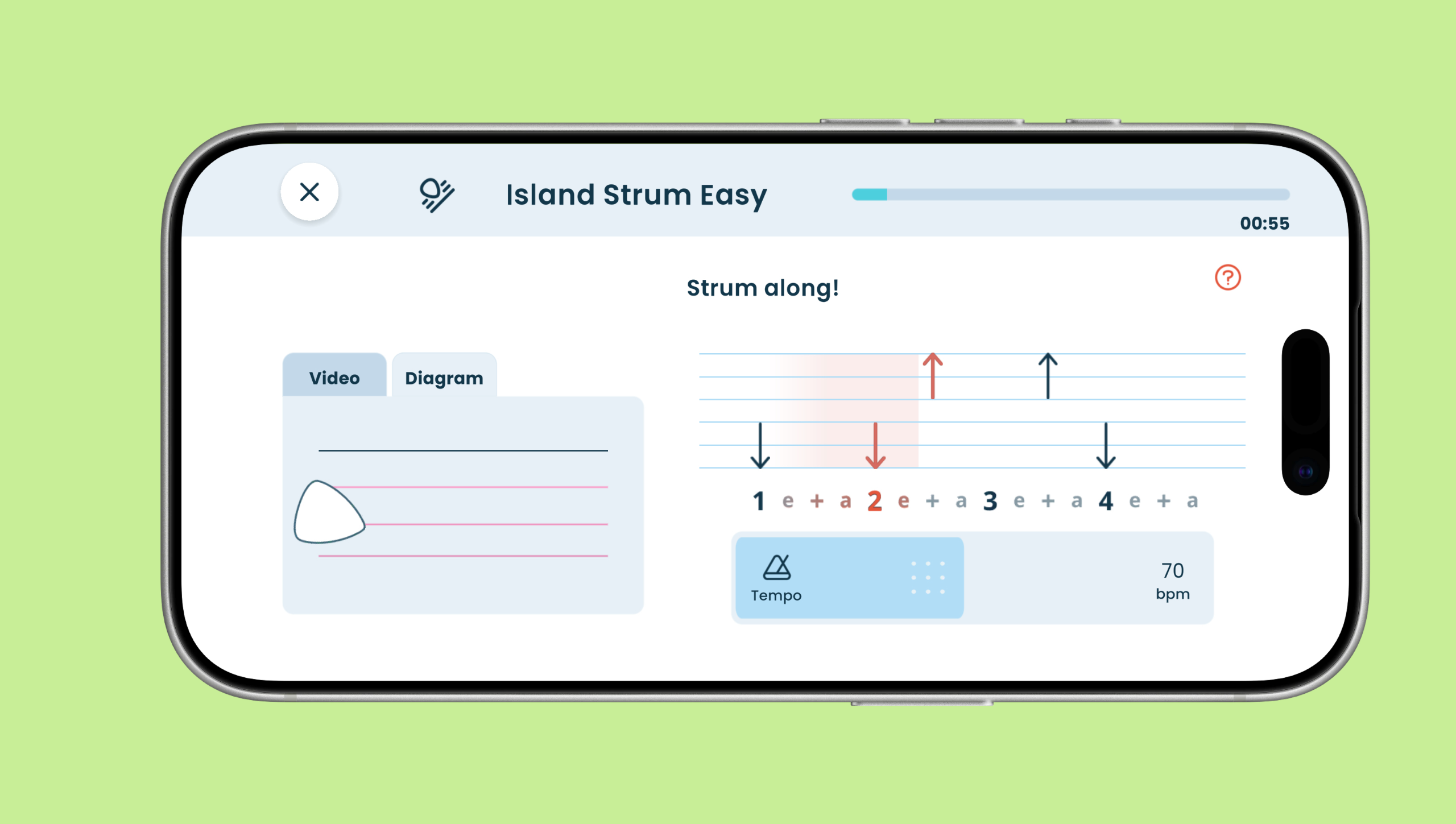
The silent downstroke is the tricky part. Your hand must keep moving downward through the air without hitting the strings. Whisper “down” on the silent stroke to keep your hand moving. Without that, most beginners freeze on the gap and the rhythm falls apart.
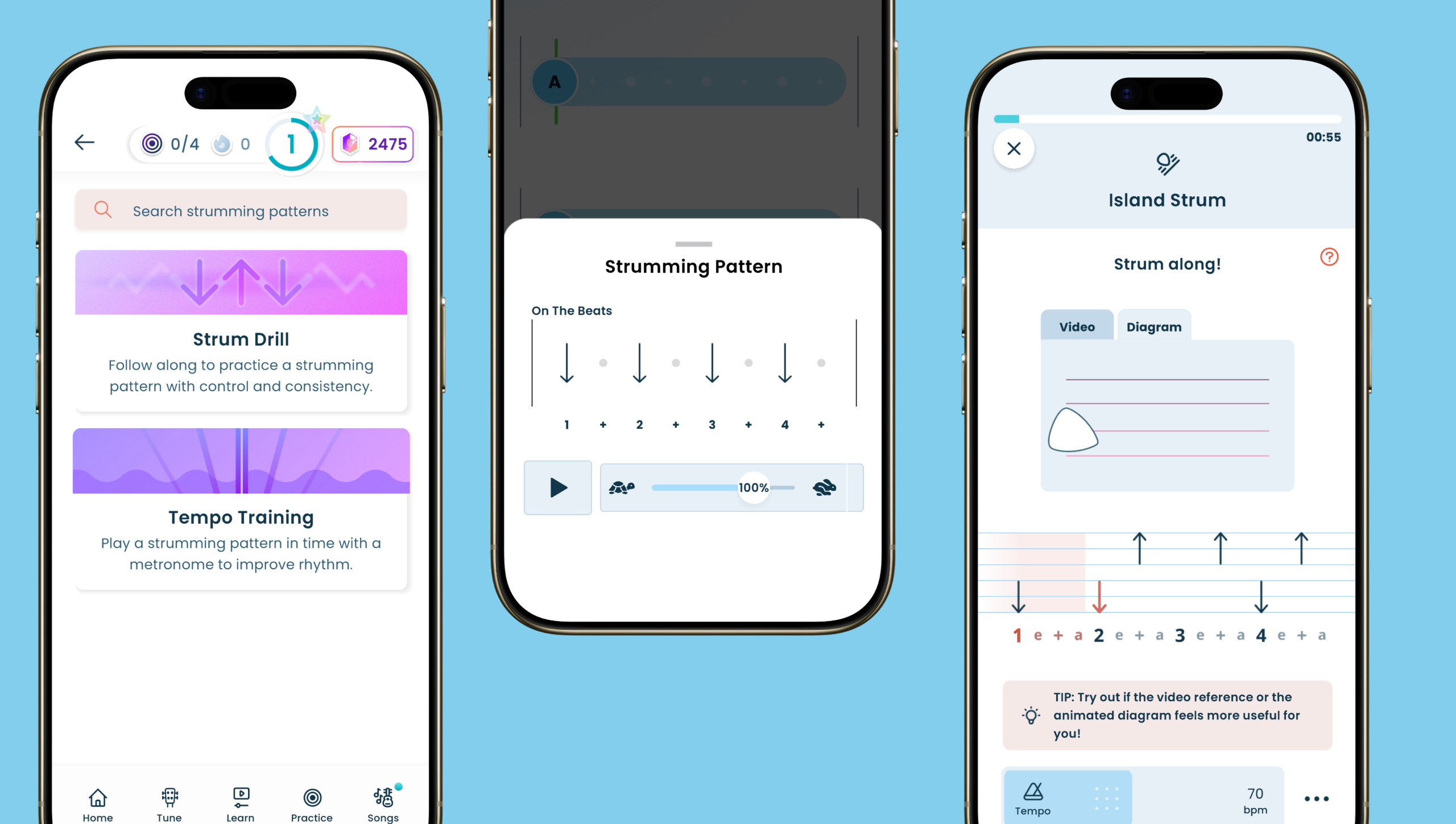
The Strum Player in the Kala App demonstrates this, and many other patterns and lets you slow the tempo right down until the motion clicks.
How do you choose the right strum for any song?
Choosing the right strum for a song comes down to listening carefully to the feel of the original recording and matching your strum pattern to that energy. There is no formula, but there are reliable starting points.
- Slow and laid-back: Start with a simple downstroke pattern, as in Three Little Birds. Let the song breathe.
- Flowing and melodic: The Island Strum usually fits well, as it does with Yellow.
- Driving and energetic: Reach for the rock strum, as in Bad Moon Rising.
- Bouncy and upbeat: Try the swing strum, as in Don’t Worry Be Happy.
If you are unsure, always start simpler. A steady D-D-D-D on any song sounds intentional and musical. A complicated pattern played badly sounds like a mistake. Build complexity only when the simpler version feels completely automatic.
Tempo is also a guide. Slower songs tend to suit patterns with more space in them. Faster songs often work better with shorter, punchier patterns that do not try to fill every subdivision. When in doubt, tap your foot to the song and strum along with your foot — that single downstroke will always be in time.
Chord transitions matter here too. If a particular chord change keeps tripping you up, use the tempo slider to slow the song to around 60% speed, isolate the two chords, and drill the switch until it stops requiring conscious thought. Then bring the tempo back up gradually. Two techniques help enormously:
- The open strum trick: Lift all fingers off the strings just before the chord change and strum the open strings. An open strum sounds better than a late or buzzy chord, and it buys your fretting hand a fraction of a second to land in the right position. This is not cheating. It’s a real technique used by real players.
- The anchor finger technique: When two chords share a finger on the same or adjacent string, keep that finger down and move the others around it. This reduces the amount of movement required and speeds up the transition significantly.
How the Kala App Strum Player helps you practice every pattern
The Kala App Strum Player is the tool that demonstrates the strumming pattern for any song in the app’s library. Rather than reading a written pattern like D-U-D-U and trying to translate it into movement, you can watch the pattern in motion, hear how it sounds at full tempo, and then slow it down to whatever speed feels manageable — all without changing the pitch.
This combination removes the two biggest barriers beginners face: not understanding what the pattern should sound like, and not having anything meaningful to practice it on. Written notation can show you the direction of each stroke, but it cannot convey rhythm. Hearing the pattern and seeing it move in real time is the difference between understanding it intellectually and actually being able to play it.
The Strum Player works particularly well alongside the other features in the app. Play Along mode scrolls the chords across the screen in time with the backing track, so you can focus entirely on strumming rhythm without memorising the song. The loop feature lets a tricky section repeat on its own so you can drill a single chord change until it’s automatic, without restarting from the beginning each time.
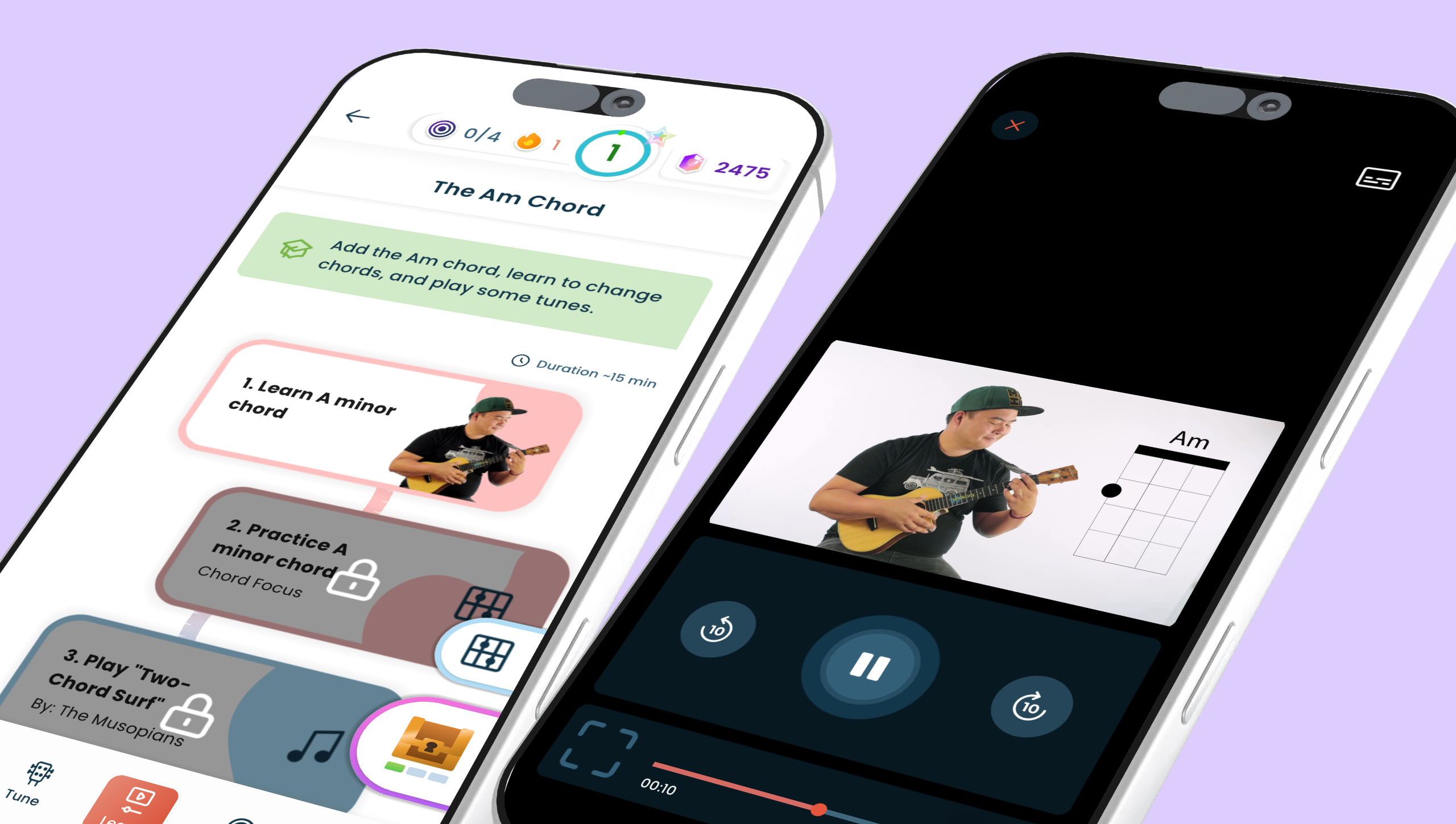
The structured Learning Path, designed by UkuLenny and Kala’s teaching team, also introduces strumming in the right order: single downstrokes first, then down-up, then more complex patterns once the pendulum motion feels natural. That sequence matters. Jumping straight to the Island Strum before the basic motion is solid is one of the most common reasons beginners stall. Try the Kala App and work through the sequence at your own pace.
Now get out there and strum something. Uke on.