
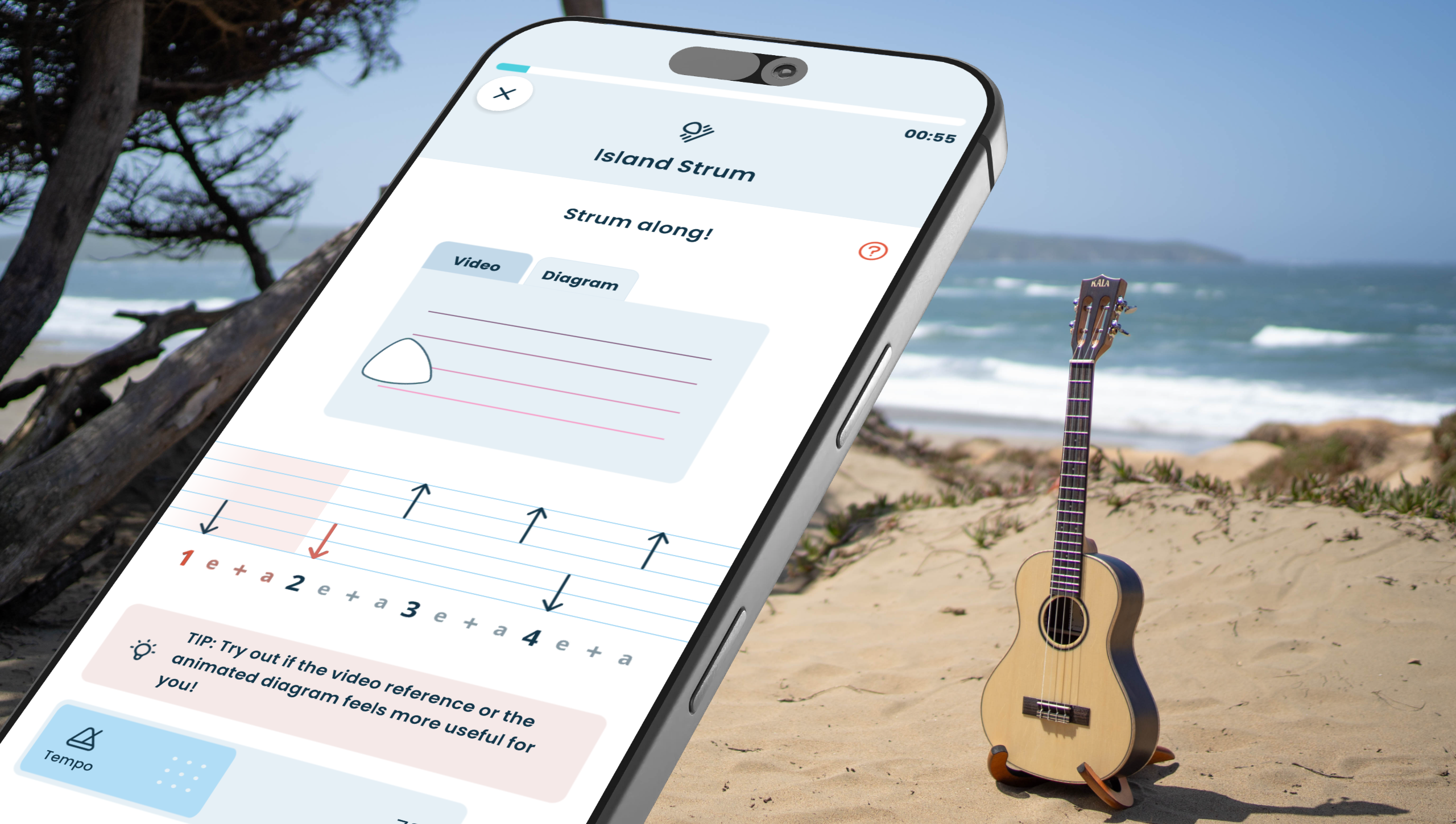
There is a reason the island strum is the first strumming pattern most ukulele players fall in love with. It has that easy, rolling bounce that sounds immediately musical — like something you would hear drifting off a beach in Hawaii or floating out of a busker’s amp on a warm afternoon. If you have been strumming down, down, down on every beat and wondering when it starts to feel like real playing, this is the pattern that changes everything.
By the end of this guide, you will be playing the island strum pattern from start to finish — broken down beat by beat, with tips for every stage of the learning curve. Whether you are brand new to ukulele strumming technique or just trying to clean up a pattern you already half-know, let’s get into it.
What makes the island strum so popular
The island strum is popular for one simple reason: it sounds great almost immediately. Most strumming patterns take weeks to feel natural. This one clicks faster than you would expect, and the payoff — that bouncy, rhythmic groove — arrives early enough to keep you motivated.
It also fits an enormous range of songs. Pop, folk, reggae, indie, classic rock — the island strum pattern works across genres in a way that more specialised techniques do not. That versatility is a big part of why it has become the go-to ukulele strumming pattern for beginners and experienced players alike. Learn it once and it opens up a huge chunk of the song library.
There is also something about the physical motion itself. Once you find the rhythm, your strumming hand almost wants to keep going on its own. It has a momentum to it — like a pendulum that has found its swing. That feeling is part of what makes learning the island strum so satisfying.
Breaking down the DDUUDU rhythm
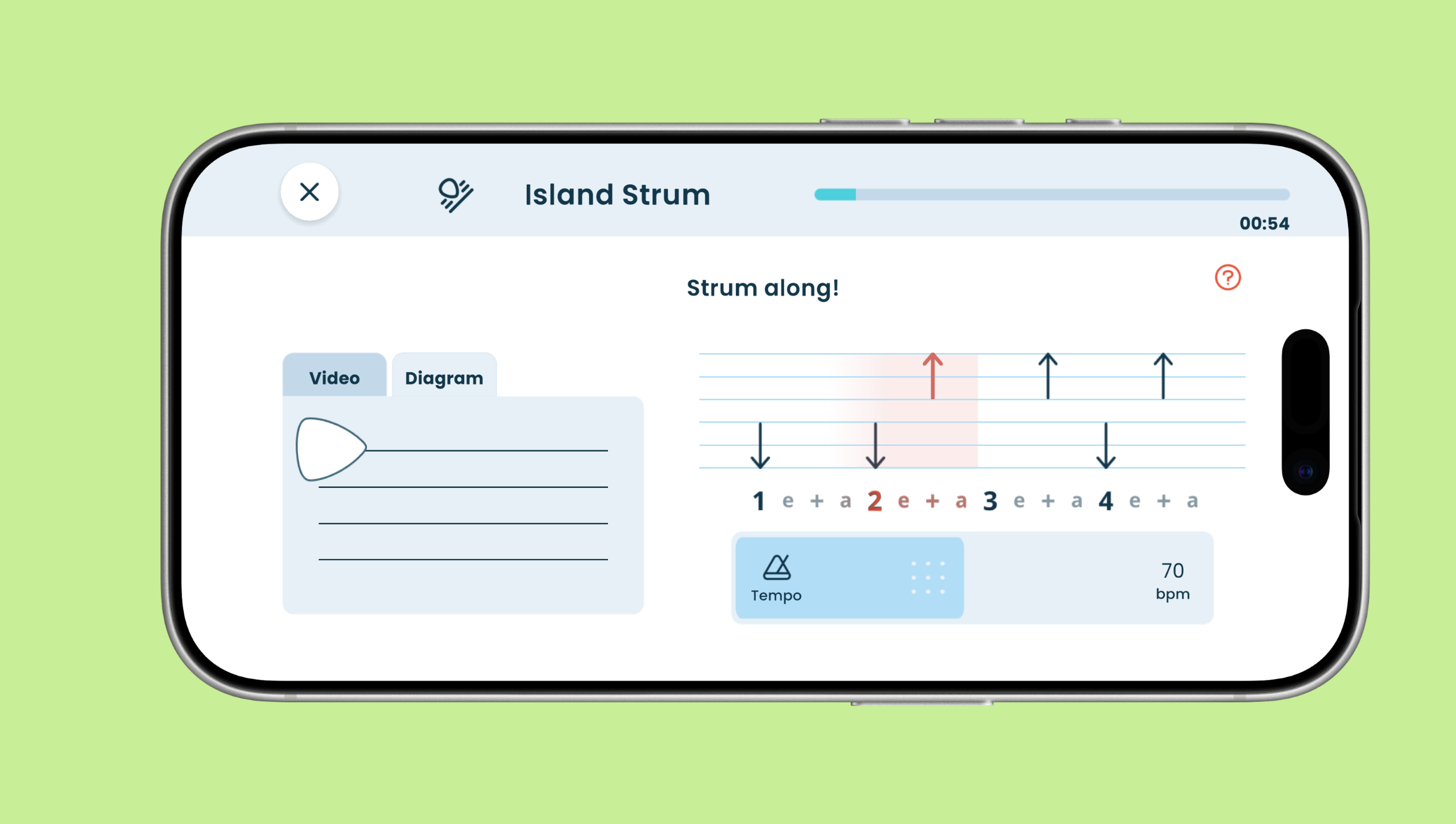
The island strum follows the pattern D – D U – U D U: down, then down-up, then up-down-up. Six strokes — but written out like that, you can already see the catch. That dash after the first D and the dash in the middle are not rests where your hand stops. They are silent beats where your hand keeps moving downward through the air without hitting the strings. The rhythm comes from choosing which swings connect, not from pausing between them.
Here is how to think about it. Your strumming hand moves in a constant up-down pendulum motion — like a windshield wiper that never stops. The trick is that not every swing actually hits the strings. Some are ghost strokes, where your hand keeps moving but floats past without making contact. The rhythm comes from choosing which swings connect.
The pendulum approach
Keep your wrist loose and let it swing continuously: down, up, down, up, down, up. Do not stop between strokes. Now, from that constant motion, you are going to mute certain upstrokes by lifting slightly away from the strings. The pattern D – D U – U D U is really just your pendulum with some swings switched off.
The silent beat — the downward swing that does not hit the strings — is the part that trips almost every beginner. Here is the single most useful tip in this entire article: whisper “down” on that silent beat. Say it quietly to yourself as your hand moves through the air. That one habit keeps the pendulum alive and stops the rhythm from collapsing exactly where it most wants to.
Start at a slow tempo. Play just the two downstrokes first — D – D — until that feels easy. Then add the two upstrokes: D – D U. Finally, bring in the last down-up: D – D U – U D U. Build it in pieces rather than trying to land all six strokes at once. The motion becomes automatic faster than it feels like it will right now, but the hand must never stop — not even on the silent beat.
How to practice the island strum at any level
Good practice is less about how long you sit with the ukulele and more about what you do while you are sitting with it. A focused ten minutes beats a distracted hour, every time.
If you are just starting out
Start without any chord at all. Rest your fretting hand lightly across the strings to mute them, and just focus on the strumming motion. No buzzing, no chord shapes to worry about — just the rhythm. Once D – D U – U D U feels comfortable as a physical motion, add one chord. C is a great starting point.
It is okay if it sounds rough at first. The goal at this stage is to keep the pendulum moving and not stop when you make a mistake. If you miss a stroke, keep going and try again on the next bar. Whisper through the silent beat every time — it really does work.
If you know the basics but want to clean it up
Try slowing the pattern right down and listening for evenness. Every stroke should have a similar weight and tone. If the upstrokes sound thin or scratchy, angle your nail slightly differently on the way up — a small adjustment usually fixes it. The Strum Player in the Kala App breaks the pattern down stroke by stroke and lets you dial the tempo back to whatever speed feels manageable, which is genuinely useful when you are trying to iron out a specific part of the pattern.
Songs that use the island strum pattern
The best way to make a strumming pattern stick is to play it inside a real song. Abstract practice has its place, but nothing locks in a rhythm like hearing it work in music you actually enjoy.
The key is to pick something you genuinely want to play. Motivation matters more than the “ideal” practice song. If you love the track, you will run through it ten more times without noticing.
Common island strum mistakes and how to fix them
Most players hit the same few snags with the island strum. The good news is that each one has a straightforward fix.
- Stopping the hand between strokes. This is the most common one. The pendulum has to keep moving even when a stroke does not connect. If your hand pauses, the rhythm falls apart. Keep swinging — and whisper through the silent beat if you need to.
- Tensing up the wrist. A stiff wrist makes the upstrokes sound harsh and uneven. Shake your hand out, loosen the wrist, and let the motion come from the forearm rather than forcing it from the fingers.
- Losing the pattern mid-song. When a chord change arrives, the strum often collapses. The fix is to prioritise keeping the strum going over landing the chord perfectly. An imperfect chord change inside a moving rhythm sounds better than a perfect chord change that kills the groove. It is okay to catch the chord a beat late as long as you keep the strum alive.
- Rushing the tempo. Excitement speeds things up. Use a metronome or the tempo slider in the Kala App to hold yourself to a pace where every stroke is clean.
None of these mistakes mean something is wrong with how you are learning. They are just the normal stages of getting the pattern into your hands. Name them, fix them one at a time, and keep going.
Now get out there and strum. Uke on.