
A down strum moves your strumming hand toward the floor; an up strum moves it toward the ceiling. Down strums land on the numbered beats of a song, while up strums land on the “ands” in between. Together, they are the two building blocks every ukulele strumming pattern is made from. The sections below unpack when to use each one, how they combine, and why your strumming might sound off even when your chords are perfect.
[IMAGE]
What’s the difference between a down strum and an up strum on ukulele?
A down strum is when your strumming hand sweeps toward the floor across the strings. An up strum is when it sweeps back toward the ceiling. On a down strum, the nail side of your index finger leads. On an up strum, the flesh side leads. That physical difference is what gives each stroke its distinct sound: down strums are fuller and warmer, up strums are lighter and brighter.
The key thing to understand is that your strumming hand is not just producing sound, it is keeping time. Think of it like a pendulum swinging down and up, down and up, at a steady pace. The pendulum never stops mid-swing. Your strumming hand works the same way.
In most popular songs, music is divided into four beats per measure. Count along: 1, 2, 3, 4, 1, 2, 3, 4. Between each numbered beat sits an “and.” The full count sounds like: 1 and 2 and 3 and 4 and. Down strums happen on the numbers. Up strums happen on the ands. Every strumming pattern you will ever learn is just a different decision about which of those positions your hand actually hits the strings on, while the hand keeps moving through all of them.
[IMAGE — HAND POSITION]
When should you use a down strum on ukulele?
Use a down strum on the main beats of the song, the numbered counts (1, 2, 3, 4). Down strums carry more weight and volume than up strums, which makes them the natural home for the beats that anchor the rhythm. In most strumming patterns, especially for beginners, down strums do the heavy lifting.
If you are just starting out, the simplest possible approach is to strum down on every beat and nothing else. That gives you a pattern of four down strums per measure, D D D D, and it is genuinely enough to play real songs. UkuLenny calls this “strum on ones,” and it is the best place to start because it trains your internal sense of rhythm before anything else gets complicated.
Down strums also tend to land on the strong beats of a song. In most pop and rock music, beats 1 and 3 are the strongest. Emphasizing those with a slightly firmer down strum gives the music a more confident, grounded feel. As your playing develops, you will naturally start to feel which beats deserve that extra weight, but for now, every numbered beat is a safe home for a down strum.
When should you use an up strum on ukulele?
Use an up strum on the “and” counts between beats, the offbeats. Up strums are lighter and thinner in tone, which makes them perfect for filling the space between the main beats without overpowering them. They add momentum and lift to a strumming pattern, giving it forward motion rather than a flat, mechanical thud.
The simplest way to introduce up strums is to add one after every down strum: D U D U D U D U, counted as 1 and 2 and 3 and 4 and. This continuous down-up motion is the foundation of almost every ukulele strumming pattern. Once your hand can do this smoothly, you are ready to start leaving some strokes out to create more interesting rhythms.
One thing worth knowing: not every “and” position needs an up strum. Strumming patterns get their character from which strokes you deliberately leave out. When you skip an up strum, your hand still moves upward through the air, it just does not hit the strings. That is the move that keeps the rhythm from falling apart, and it is something the next section covers in more detail.
How do down and up strums combine into a strumming pattern?
Down and up strums combine into a strumming pattern by deciding which positions in the 1-and-2-and-3-and-4-and count actually hit the strings, while the hand keeps moving through all of them. The pattern is not about which direction the hand moves, it is always moving in both directions. It is about which strokes make contact and which pass through the air.
The most important principle here is this: the hand never stops moving. Whether you are playing a simple four-beat pattern or a more complex rhythm, the strumming hand swings down and up at a steady pace throughout. When you deliberately miss a strum, your hand still travels through the motion, it just does not touch the strings. This is what keeps the timing consistent. The moment the hand stops between strokes, the rhythm collapses.
Here is how that looks in practice with the most popular ukulele strumming pattern:
Pattern: D D U [miss] U D U
[VIDEO NEEDED]
That gap in the middle, the missed downstroke, is what gives the pattern its bouncy, island feel. The hand still swings downward through the air on that beat; it just does not hit the strings. UkuLenny’s tip for getting this right: whisper “down” on the silent stroke to keep the hand moving. Without that internal cue, most players stop the hand and lose the rhythm entirely.
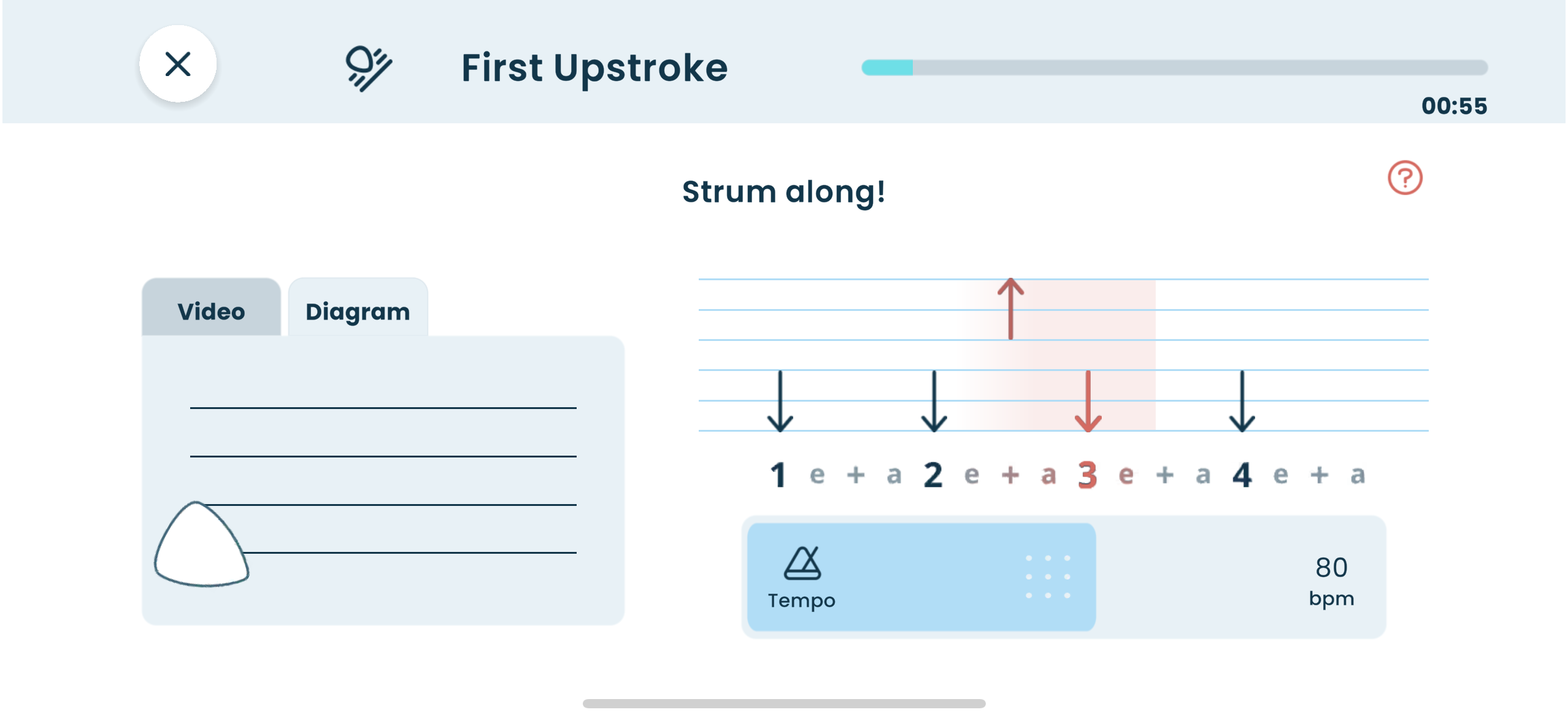
The Strum Player in the Kala App breaks down exactly this kind of pattern, showing the D-U notation and letting you slow the tempo right down until the motion feels natural before you speed back up.
[IMAGE — SCREENSHOT]
Why does your strumming pattern sound off even when the chords are right?
If your strumming sounds choppy or mechanical even though your chords are correct, the most likely cause is that your strumming hand is stopping between strokes. The second most common cause is a late chord change, the chord does not land in time, so the rhythm stumbles even though the pattern itself is right. Both problems feel like a strumming problem, but they have different fixes.
When the hand is stopping
If your strumming hand pauses between strokes, the pendulum-like motion breaks down and the pattern sounds uneven. The fix is to practice the strumming motion on its own, without worrying about chords at all. Lay your fretting hand flat across all the strings to mute them, then strum the pattern. No chord shapes, no finger positioning, just the strumming hand moving continuously. This isolates the motion and lets you build the muscle memory for keeping it going.
When the chord change is late
A chord that arrives even slightly late creates a gap in the sound that feels like a rhythm mistake. The open strum trick helps here: just before you need to change chords, lift all your fingers off the strings for one strum. An open strum sounds fine; a late chord does not. This is not cheating, it is a real technique. From there, practice the transition between just two chords at a slow tempo until the switch feels automatic. The tempo slider in the Kala App lets you slow a song down to whatever speed feels manageable, which is exactly the right environment for drilling a tricky chord change.
The wrist can also be a culprit. If the strumming motion is coming from the elbow rather than the wrist, the movement becomes stiff and effortful. Shake out your hand, pretend you are flicking water off your fingers, and then strum. That loose, hinge-like wrist motion is what you are after. Once the hand is relaxed and moving freely, the pattern tends to fall into place faster than you would expect.
Now get out there and strum. Uke on.