
Different music genres call for different ukulele strumming patterns, and matching the right rhythm to the right style is what makes a song feel convincing rather than just technically correct. The pattern you use for a reggae track should sound nothing like the one you’d use for a country ballad, even if both songs share the same four chords. Below, you’ll find direct answers to the most common questions about ukulele strumming patterns across genres, so you can start applying the right feel to the songs you actually want to play.
What strumming pattern works best for pop songs on ukulele?
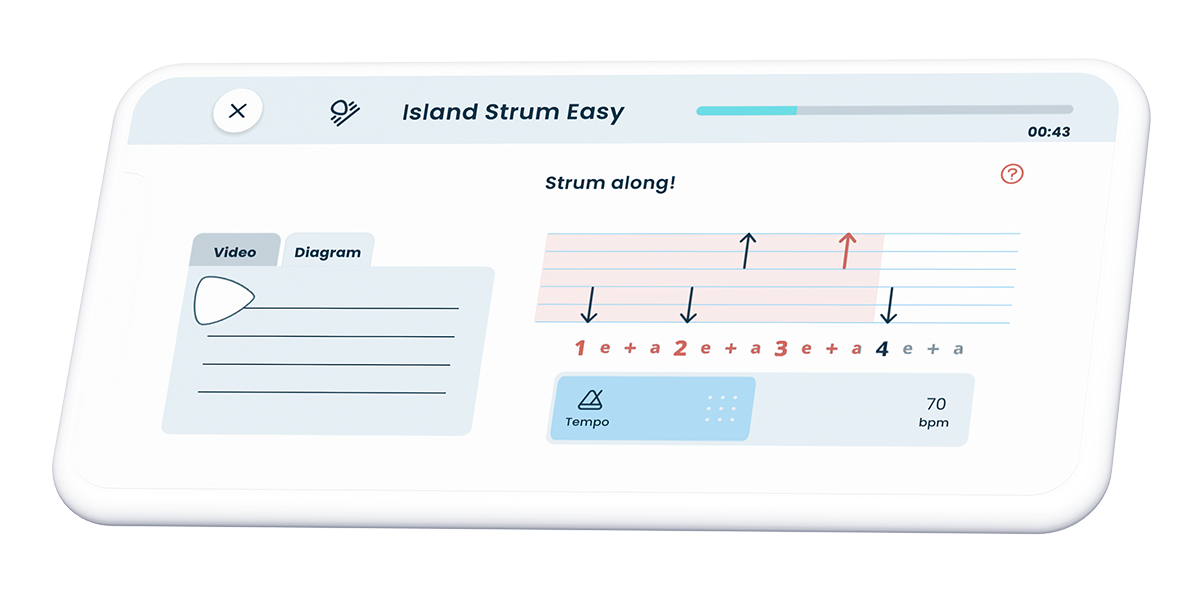
The island strum is the go-to ukulele strumming pattern for pop songs. Written in D-U notation, it looks like this: D-D-U–U-D-U, where the dash represents a deliberate miss — your hand keeps moving through the air but skips the strings. This single pattern works on the majority of pop songs in 4/4 time and is the pattern most players reach for first.
[VIDEO NEEDED]
The tricky part of the island strum is that silent downstroke on beat three. Most beginners stop their hand when they’re supposed to miss, and that’s what breaks the rhythm. The fix is simple: keep the hand moving continuously, like a pendulum, even when it isn’t hitting the strings. UkuLenny’s tip is to whisper “down” on the silent beat to keep the motion going. Once that click happens, the pattern starts to feel natural.
Pop songs with a driving, energetic feel sometimes call for the rock strum instead: D-D-D-D-U, with a slight accent on each downstroke. Think of anything with a steady, propulsive beat. The accent is what gives it energy, not just the pattern itself. Start with the island strum as your default for pop, and switch to the rock strum when the song needs more forward momentum.
The Kala App‘s Strum Player shows the exact pattern for each song in the library and lets you slow the tempo right down while you build the muscle memory. That’s worth using before you try to match full song speed.
How do you strum a ukulele for reggae and ska rhythms? 🎵
Reggae ukulele strumming emphasizes the offbeats rather than the downbeats. In a standard 4/4 count, instead of accenting beats 1, 2, 3, and 4, reggae accents the “ands” between them. A common reggae pattern is -U–U–U–U-, where only upstrokes land and the downbeats are deliberately skipped. This creates that characteristic bouncy, laid-back feel.
[VIDEO NEEDED]
Ska takes a similar offbeat approach but at a faster tempo and with more rhythmic punch. Where reggae sits back, ska pushes forward. The upstroke emphasis stays, but the overall energy is sharper and more clipped. A useful way to think about it: reggae leans into the space between the beats, ska springs off it.
Both styles can feel counterintuitive at first because you’re essentially training yourself to ignore the downbeat, which is where most beginners naturally land. Start by tapping your foot on beats 1, 2, 3, and 4, then strum only on the “ands” while your foot keeps the pulse. Once the foot and hand are doing different jobs comfortably, the reggae feel starts to click.
What’s the difference between folk and country ukulele strumming?
Folk ukulele strumming tends to use a flowing, even rhythm with a mix of down and upstrokes, often in 3/4 or 6/8 time for ballads. Country strumming leans on a stronger backbeat emphasis and frequently uses a boom-chick feel, where a single bass-string pluck alternates with a strum. The core difference is feel: folk is smooth and continuous, country is rhythmically punchy and syncopated.
For folk songs in 4/4, the basic D-U-D-U-D-U-D-U pattern works well, and the swing strum, where downstrokes are held slightly longer than upstrokes in a two-to-one ratio, gives folk music its characteristic lilt. Songs in 3/4 time, which appear more often in folk than in almost any other genre, use a simple D-D-U per measure, with a gentle accent on beat one.
[VIDEO NEEDED]
Country strumming on ukulele often mimics the guitar’s boom-chick pattern by plucking the G or C string on beat one, then strumming the remaining strings on beats two and four. The backbeat (beats 2 and 4) gets the emphasis, which is what gives country its rhythmic swagger. It’s a slightly more advanced technique than a straight strum pattern, but it makes country songs feel immediately recognizable.
How do you play jazz rhythms on a ukulele?
Jazz ukulele rhythm relies on the swing feel, a timing approach where eighth notes are not played evenly but in a long-short pattern, roughly two-to-one. Written notation cannot capture this accurately, which is why jazz strumming must be heard rather than read. The basic direction is down-up, but the “down” lasts twice as long as the “up,” giving the rhythm its rolling, relaxed quality.
[VIDEO NEEDED]
Beyond the swing feel, jazz ukulele often uses chord stabs, short, percussive strums on specific beats rather than a continuous pattern. Beats 2 and 4 are the typical landing spots, which is where jazz rhythm players traditionally emphasize the pulse. Letting the strings ring briefly after each stab, rather than muting them immediately, keeps the sound warm rather than choppy.
Jazz also opens the door to more complex chord voicings, seventh chords, ninth chords, and altered shapes that give jazz its distinctive harmonic color. If you’re new to jazz rhythm on ukulele, start with the swing feel on simple chord progressions before adding more complex harmony. Getting the timing right matters far more than the chord complexity in the early stages.
How can you practice multiple strumming patterns without losing progress? 🎯
The most effective approach is to practice one strumming pattern at a time across multiple songs rather than switching between patterns in a single session. Depth beats breadth when building muscle memory. Once a pattern feels automatic on two or three songs, add a new pattern and apply the same process. This way, each rhythm becomes genuinely internalized rather than vaguely familiar.
A few habits that make multi-pattern practice sustainable:
- Use muted strings to isolate the strumming hand. Lay your fretting hand flat across all four strings to mute them, then practice the pattern without any chord pressure. This removes the mental load of chord shapes entirely and lets your strumming hand focus on the motion alone.
- Slow down before you speed up. A pattern practiced slowly and cleanly at 60% tempo will transfer to full speed faster than a pattern practiced sloppily at song tempo. Use the tempo slider in the Kala App to find the speed where the pattern feels comfortable, then build from there.
- Rotate patterns weekly, not daily. Switching patterns every day prevents any single rhythm from becoming automatic. Give each pattern enough time to settle before introducing the next.
- Apply each pattern to a song you actually like. Abstract strumming practice is harder to stick with than playing a real song. Pick a track from the song library, apply the pattern you’re working on, and let the song give the rhythm its context.
It’s okay if a new pattern feels awkward at first. That’s not a sign you’re doing it wrong, it’s just the hand learning a new sequence. Keep the hand moving continuously, even through the stumbles, and the pattern will settle faster than you’d expect. Ready to put it all into practice? Try the Kala App and start playing the songs you love today. Uke on.